|
Memoirs of Reg Bulled
Life in the Camps
There was no running water in Changi, so all we used had to be carried in from outside the camp. Although we bitterly complained to our officers about the lack of food we really knew there was not much they could do about it. Breakfast consisted of one hard square army biscuit and a cup of weak tea. Lunch was the same and for a treat at supper time we got an extra biscuit.
Many of our drivers had been forced to drive for the Nips - they let us know this was the name we had to call them. They said they were Nipponese but we still thought they were Japanese. Our drivers used to make two or three trips to Singapore City and were willing to take a chance on doing a little bartering with the natives. Those men with money and those with items to sell gave it to a driver in faith and asked him to get whatever he could in the way of food. They soon found out that the prices had risen out of all reason. A can of milk that used to cost 25c now cost $5. Having lost everything in the sinking ship I had nothing to barter with. The officers, though they said we should not barter with the enemy, certainly took every chance they had and so lived fairly well, much better than the rest of us. This led to bitter resentment among the troops. Soon we felt the first problem of our starvation diet, constipation. Men were not having bowel movements for weeks and finally, when it became too painful to bear any longer, reported sick and received the good old army number nines.
We were taken out on work parties to restore houses for the Nip officers and to collect wood for the kitchens. Some of the guards were brutal and thought it great fun to beat us, knowing we could not fight back. Many a man came back from one of these parties cut and bleeding from the treatment he had received. Other guards were good and if we were near water would let us swim during our break time. Things didn’t seem too bad and we thought that when the Nips started to feed us properly, we would be able to take this life. To our dismay, all the sick and wounded were taken out of the hospitals in Singapore and sent up to join us. This made for tremendous overcrowding. There was also the problem of caring for these men without adequate drugs or medicines. There were no bedpans and no running water, so all bandages and soiled bedding had to be taken down to the sea a mile away and washed by hand without soap.
There was a railway line which had a large break in it about halfway. We used to fill a railway truck with the dirty washing, push it to the break, and there transfer it to another truck on the other side of the break, and so continue on down to the sea. We had to do the same coming back. This was a work detail everyone used to hate and would try to dodge whenever possible. After a while some spare railway lines were found and carried down to the break and there laid on the existing ties so that with an extra push we were able to get the one truck all the way down to the sea. That saved time and energy. But if we were not on any of these work parties we found we were not allowed to sit around and rest. Our officers had evidently been told that the biggest worry in a prison camp was boredom, so they stretched their imagination to the limit to find things for the men to do to relieve this supposed boredom. It never seemed to occur to them, as they lounged around their quarters playing cards and being waited on by their batmen, that the men not being forced to work for the Nips needed to rest because of their weakened condition. But like good soldiers we kept the officers happy in their belief that they were still in charge.
Up until now we had had little interference from the Nips. We had free access to any part of the camp and this we enjoyed as it enabled us to visit with friends. But the enemy soon decided that it was time they took control of the camp and so set up road blocks to different areas. We had to bow and ask the guards permission to proceed past the barrier. This was galling enough to say the least but it was made worse when the Nips put traitor Indian troops to manning the posts. It was very humiliating to have to bow to these turncoats and ask their permission to proceed. The evenings were the worst times as, without any work to occupy the mind, time hung heavy and thoughts would turn inward and homeward.
One evening as I sat on my bed space feeling very hungry and depressed, a soldier came by and said he had just been to a hymn sing. Immediately my spirits soared and I asked him where these sings were held. He told me there would be one every evening held by a padre. The next evening I accompanied this friend to the gathering, about 25 soldiers and the Padre. He called it “Singing mothers favourite hymns.” It was truly a tonic. What a joy ran through us as we sang the old well-known hymns of the faith. After a few nights, the Padre started to give the history behind the writing of some of the hymns, then he started opening and closing with prayer, and finally gave a short message. It was like old times going to church and it revived memories of the open air meetings. For a couple of hours, as we sang and talked, we could forget our condition. After each evening was over, we made our way back to our beds to sleep but lay awake thinking of our loved ones back home.
One day when I returned from a firewood detail we found that there had been a consignment of jam from the Red Cross. Of course those that were there all day had the first pick so when I got up to the table for my issue, all that was left were tins of tomato jam. If there was one thing I heartily disliked it was tomatoes, but when I opened it and put it on my rice portion, I realised it was the most delicious jam I had ever tasted. I believe it was an Australian product. Not only did we enjoy the jam but our hopes were lifted that now the Red Cross had started to send us help, we would receive regular parcels. What a hope! We only had one more parcel in the three and a half years.
About this time our officers decided that all men not with their original regiments should return to them. So reluctantly I said goodbye to those with whom I had shared the ups and downs of action in the prison camp life so far and returned to my own unit, the 18th Division Royal Corps of Signals. They were quartered in the other rank’s married quarters and the billets were a big improvement over tents. Our cookhouse also was under cover. It had been the indoor rifle range and was on the edge of the parade ground. Just after moving into these new quarters, two new problems raised their ugly heads; one was insomnia and the other was nicknamed “happy feet.” I was fortunate to suffer only from the first of these maladies; those with the second spent most of their nights walking around the earth paths trying to cool their burning feet.
It was at this time that our spirits were at their lowest ebb so far. In this new area I could no longer attend the hymn-sings. Everything seems worse in the dark hours of night and as I sat propped up against the wall, my thoughts would naturally turn to home and the loved ones left behind. I don’t know which was worse, the starvation or the fear we had been forgotten or written off as dead. I wondered what had happened to the other members of my Bible class who had been called to the colours. We had all spent a few years together studying God’s Word and having happy fellowship with one another. We had helped to share each others problems and concerns; we knew our friends were always there to help us. Now I was alone! No! That is not true, because I had a friend who had promised never to leave or forsake me, my Saviour and Lord, Jesus Christ. How we longed to hear a familiar voice, to feel a caressing touch. How long before this living nightmare would end? Little did we know that the time would come when we would look back on Changi as a luxury camp.
We felt very sad as we watched every day the little procession going to the cemetery. It never entered our dreams that this was only a trickle and that before we could be released we would go through times of utter brutality, starvation, inhuman working conditions, beatings and above all, terrible pain and sickness and see unbelievable numbers die.
During our night walks around the pathways, we were drawn to the kitchen area from which some wonderful smells were wafting our way. The cooks made sure we didn’t get too close but there was no doubt in anyone’s mind that the best part of our rations was being cooked at night, solely for the benefit of the cooks. Naturally there were a lot of complaints to our officers about this nightly activity and finally they decided to change all the cooks and kitchen staff. At one evening meal we were introduced to an officer who would be in charge of the kitchen and supplies. He picked out a new staff to work under him. Why I don’t know, but I was one of those detailed. I couldn’t help thinking I was following in my father’s footsteps; he had been a baker in the desert in the First World War, after being wounded in France. At our first talk with this officer we soon found out he would stand for no nonsense. He made us cook everything that was allotted for that meal and told us how much to serve each man. He stood by and watched to see that no-one received special treatment. When everyone was served he served us in full view of the rest of the men. The Japanese had now started to supply us with food - bags of rice which were full of dirt, rat and mice droppings, weevils, cigarette ends and maggots; in other words, the sweepings of the floors of the warehouses. Often the rice was heavily impregnated with lime which made it almost impossible to eat. We heard that this rice was initially meant to be dug back into the ground as a fertilizer
The Japanese used to drop off all the rations, including baskets of vegetables, on the parade ground next to our kitchen which was very convenient for us. Each regiment would send a detail over to collect their rations. We thought things were going to improve when we saw the baskets of fresh vegetables, but we soon found out that the word “fresh” didn’t belong in the same sentence with the vegetables. Most of the vegetables were rotten and the medical officer condemned a large portion of it, sometimes even all of it. We asked for permission to pick it over and would cut piece off this vegetable and a piece off that, and added to our rice they made a tastier and more filling meal.
It is amazing how men, suddenly away from all that they had known, all that they believed in and everyone they had relied upon, react in different ways. It has been said that captivity brings out the worst or best in a person, and we began to see the truth of this statement. It is also amazing how ordinary men can suddenly become geniuses and through their ingenuity and endeavours help others to rise above their circumstances. In our kitchen staff we had such men. First we built home-made ovens, and then a preparation room in the kitchen area. The window was covered with a piece of mosquito netting so that while fresh air could come in, the bugs were kept out. Also, the doorway had two sets of mosquito nets; you made sure one was closed before entering through the next. Inside this room, on tables made from scraps of wood, toiled the prep cooks, of which I was one. Some would take the rice and, with bottles, grind it down to smaller pieces and still others would grind it down into rice flour. With these ingredients our only limit was our own imagination and ingenuity. We made little rice cakes baked in the home-made ovens, and with a little pureed sweet vegetable on top they looked and tasted good. We also made apple turnovers this way. We had no apples but with some boiled and mashed vegetable marrow, with a few cloves added, you could almost think you were eating the real thing. We started making our own bread with sour yeast, so that every third day each man received a slice with his evening meal; although it had a vinegary taste it was good to chew something. One day someone found some ginger root and as we had no idea how much to use, we nearly burnt out the tonsils of all the men, but we learned.
Now, at least with the extra vegetables we were able to salvage from the storage area, although getting them was far from a pleasant task as all the vegetables were bad somewhere if not all through and the smell left a lot to be desired, our meals were at least a bit more varied. Breakfast consisted of pap rice, that is rice boiled to a watery consistency which was supposed to resemble porridge, and a cup of weak tea, no milk or sugar. Lunch was again the never far away rice with any little titbit the cooks could manage to salvage. The evening meal was, guess what? Rice, again with a little weak vegetable soup and a treat in the way of a piece of bread or one of our famous little cakes. The cakes had been nicknamed “dofors”, they would do for you or for me, or they would do for today or tomorrow, whichever you pleased. I don’t think many were kept for tomorrow in case the rice became sour.
Life had begun to settle into some kind of routine. The Nips left us alone and we only saw them as they drove through the camp. The one thing that really marred our day was the little procession through the camp gate; men carrying stretchers bearing the remains of comrades who had finally succumbed to their wounds, often a death hastened by the lack of nourishing food and the almost total failure of the Nips to supply medicines and drugs. The doctors were amazing, the tremendous operations they performed, often by the light of candles or home-made lamps and usually with makeshift medical implements.
Suddenly our life completely changed! As I look back on this time in my life I realise that this was the beginning of all the brutality and sadism that was to be our part until the end. The Japanese high command had informed our senior officers that all men had to sign a form promising not to try to escape. Our officers told us in no uncertain manner that if we signed such a document we could be tried for treason when we got back to England. Actually, one could only wonder at the mentality of our captors as we, and surely they must have realised the impossibility of escape. Our colour was against us to start with, then between us and the nearest allied troops were thousands of miles of jungle and mountains On top of that, the local natives would certainly turn us in for the huge bounty the Nips were placing on each one of us. So we all refused to sign. The Japanese countered with an order that all men must proceed, on foot, carrying all they wanted to take with them, to a barracks a few miles down the road - Selarang Barracks.
|
|
|
Selarang Barracks Incident
|
|
By Charles Thrale
|
|
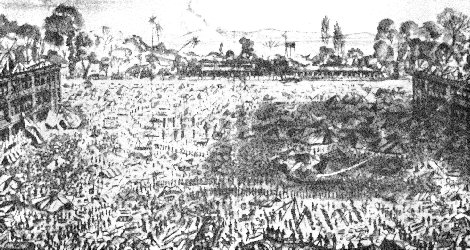
There we were incarcerated in less buildings than we had been used to and all those who had been in tents had to join us. Fifteen thousand officers and men were herded into a barracks built to house one battalion. But with the typical joking of the British Tommy we started digging latrines in the middle of the barrack square, while on top of the earth that was thrown up at the back of these trenches, the cooks were setting up their kitchens. It wasn’t the ideal as far as being sanitary; you would climb up the bank to receive your ration while on the other side men were relieving themselves.
I guess all the laughing and joking really upset the Japanese officers, so they attacked us again through our rations. They reduced them to half a cup of boiled rice a day and that was the infamous limed rice. After a few days of this treatment, when we still had not given in and still refused to sign the documents, they gave us another ultimatum. They gave us another 24 hours to sign or else they would send all the sick and wounded from the hospitals to join us. This was sheer murder and showed their utter and complete indifference as to whether we lived or died. If we died so much the better, they wouldn’t have to guard or feed us. Our senior officer managed to get them to add to the bottom of the documents “signed under duress”. This, we were told, made it possible for us to sign without fear of Court Marshall.
We all moved back to Changi again and this time I did not get my spot in the married quarters but was billeted on the top floor of a wooden, two-storied building, almost against the bamboo fence and just to the right of the gate as you left the camp. It was pleasant enough as we could look down the road outside the camp, and see activity and things happening. The only thing to mar the view was the cemetery with its ever increasing rows of white crosses just outside the fence on the other side of the gateway. Each day we went through the sad period of time as we watched the funeral processions taking the mortal remains of dead comrades to their last resting place. Young men who had left home, most before reaching the age of 21, now buried in a grave on Singapore Island.
When the Scots regiments buried their fallen comrades the procession could be heard coming for quite a while before you could see them; the wail of the bagpipes as the pipers played a lament. Soon the spare piece of ground began to fill up as more and more of the wounded died, often unnecessarily, joined by those who had become victims of disease and because of the lack of food did not have the willpower to get well. We could only hope that one day the Nips would be made to answer the charge of deliberate murder. As we watched day by day fear always entered our hearts and we wondered if this is where we would end our days.
One day it came to me that the next day would be my 21st birthday. I guess I must have mentioned the fact to others as the next day one friend handed me two bananas and another one a hard boiled egg with their best wishes. These gifts may seem very small and insignificant but to men who had very little and who themselves were starving, it was all they had. Naturally my thoughts went back home again and I wondered what my parents and fiancé were thinking. I wondered above all, whether they knew I was still alive! I longed to be with them or to be able to send a letter. I thought of all the lovely presents I would have received if I had been in England, but they were nothing compared with what my two friends had given me. Once again, in the quietness of that night, I thanked God for saving me and prayed that He would give me the strength and help needed to see this through to the end.
It seemed as if the Nips were satisfied with the documents we had signed and were going to leave us alone in this camp. We looked forward to the day the International Red Cross would inspect our camps and see our starving condition and lack of medicine and start to send us help and food parcels. Unfortunately all these wonderful thoughts were just figments of our imagination, spurred on more by hope than common sense. The enemy had already made it plain to us that they did not recognise the Geneva Convention on the treatment of POWs. We received only one parcel from the Red Cross in three and a half years of captivity and at that time each parcel had to be shared amongst 13 men.
The Nips started demanding small work parties each day and took them to Singapore to start cleaning up the place. Then came a demand for two large work parties. They had to parade the next day with all they wanted to take with them as they would not be coming back. We were not told what these work parties would be doing, just that they were going to Singapore city. News soon filtered back to us that these men had been moved into two different areas and while some stayed to build huts to live in the rest were sent to work in the town. We heard that the guards were treating them brutally and the food was very poor. Soon another party was wanted and it fell to the lot of my unit to supply the men. We were bundled onto trucks and started down the road to the city. As we passed the civilian prison we saw white handkerchiefs being waved out of the windows and we knew that this was the female white internees and their children. We waved back and shouted words of encouragement, much to the annoyance of the guard on each truck As it was, he was very much on edge being alone with a truckload of prisoners and obviously scared something might happen to him, so when we began cheering and making so much noise he became very uptight and screamed at us to be quiet - at least that is what we thought he was saying. But we sympathised with the civilians in prison as rumours spread how the soldiers treated all women as only objects for satisfying their animal lusts. Although we cheered and laughed and outwardly seemed to be enjoying life, actually within we were full of fear, not knowing where we were going or what was waiting for us at the end of our journey.
Finally we arrived at what was to be our new camp - Keppel Harbour. It was built in a triangle, bounded on one side by a high wall behind which we believed to be a dry dock and the harbour and ocean on the other two sides. The guardroom was in the point of the triangle so that everything going in or out of the camp had to pass it. At one end there were showers and a jetty. The toilets were little boxes built over the sides of this jetty so that one was actually hovering over the water. Rather embarrassing when ships carrying repatriated Japanese civilians passed us quite close. Here we slept in a fairly large hut built with cement blocks. The beds were benches made of wood and everything was clean and with lots of windows - no glass - and doors, so it was very bright. Unfortunately the bed planks soon became infested with bed bugs and once again life was made very uncomfortable at night.
We were paraded and one of the Nip officers explained our duties. We were to be used as stevedores on the docks, loading and unloading the boats. We would get every third day off and better rations. This cheered us a little but we remembered the previous promises of the Nips that never came through. Our camp was under the control of a small number of officers with Lieutenant-Colonel Flowers of the Northumberland Fusiliers as the senior. He was a stickler and ran the camp as if we were still in England and free men. Once a week he would walk through the ranks and order haircuts, and if any man broke one of the laws he had set then he was put on a charge and the colonel meted out punishment. The usual was so many days of extra work The man did his shift for the Nips and when he came back to camp, instead of having a shower and relaxing, he had to report to the cookhouse for fatigues. If the crime was serious enough, the colonel would order the man into a cell he had made instead of being able to relax on his bed space.
These things did not go down well with the men but we admired him because he was absolutely fearless regarding the Nips. If he wasn’t happy about something he would march out of the camp and as he passed the guardhouse with the guard commander screaming at him, he would just say “Going to No. 1,” This way he let them know he was going to Japanese headquarters to register a complaint. Nothing stopped him, he was over 6 feet tall and it was comical to see a little Japanese soldier, trailing a rifle and bayonet bigger than himself, running to try and keep up with the colonel.
Every morning we had to parade after breakfast to be counted and those designated to work that day marched out of the camp to one of the other docks to work. We never knew what we would have to do when we arrived there. The one thing we hated was loading angle iron, it was so twisted it bounced on your shoulders and made them very sore. Another thing we hated to load was cement; the dust got into every pore and, with the sweat, made you very sore. It was difficult to get the dust off your flesh in the shower. But the worst of all was to load onto a ship which was used as a brothel. It seemed that every Japanese regiment had their own brothel which went with them wherever they went. The prostitutes used to smell bad and it was a disgusting sight to see them being used by the soldiers in the bottom of the holds.
Although the Nips had kept their promise - at least so far - of every third day being a rest day, their promise of increased rations had not been kept. We had begun our education in the lack of integrity on the part of our captors and began to learn never to believe anything they promised. They expected us to work hard on the same rations we had received at Changi and we realised that this would soon take its toll. The work was hard, especially for those who had never been used to manual labour. On top of this we were introduced to the mad screaming of our guards and the persistent yell to “speedo, all men speedo.” If we still didn’t move fast enough, or the guard felt it was about time he showed his authority, then we were assaulted with bamboo canes. We were not the only ones treated this way; the civilian population were made to work on the docks and were treated to the same abuses as the military. When they were coaling a ship there would be two long lines of Chinese women, one line shuffling along with a basket of coal hanging from each shoulder, up the narrow gangplank and then back along the other line with empty baskets. They kept this up hour after hour and we wondered if they were still as happy with the Japanese as they were when we surrendered. I well remember one Chinese lady who was very obviously pregnant but this did not save her from the abuse or beatings of the guards. Then we noticed she was missing from the line and a couple of hours later she rejoined the line with a new born baby on her back. What a life!
At first our working day was not too bad in length; we usually left camp around 8.30 am and arrived back at about 5:00 pm. But we soon realised that we were at the mercy of the enemy and if we had finished our ship and there was another not finished, then we would be marched over there to help, and we arrived back at camp sometime in the evening. With a little ingenuity and a lot of covering up for one another we soon learned how we could not only dodge some of the work, but also increase our food supply.
We found that the go-downs - warehouses - were mainly filled with English food that the Japanese had captured and they didn’t seem to like it or want it. So we decided to liberate as much as we could. We would take turns in small groups, hiding out and then scrounging around to see what we could find. Some things such as canned fruit, canned meat and canned condensed milk we ate straight away. But time was limited so we filled our haversacks with other tins to take back to camp. Some of the cans of condensed milk had been touched by heat from the fires and the milk had a caramel taste, it was delicious. It was always a tense moment when we marched back past the guard room at the entrance to the docks with our haversacks full of plunder. Would we be searched or stopped? We arranged that all men with something to hide would march in the centre file and towards the back, because if we were stopped they always stopped the column at the guard room so it would give time for those at the back to get rid of things. When we neared the guardroom we closed up ranks and marched smarter than the guards at Buckingham Palace. This pleased the Nips and when we had to salute them, the N.C.O. in charge would roar out “eyes right” and you could almost hear the eyes snap as the men looked to the right. The guards were thrilled and we were happy to oblige, especially if it stopped them from examining the contents of our haversacks.
We could never understand the mentality of a people who see a large number of men enter the docks carrying empty haversacks and leave the docks with full ones and never wonder why. Sometimes a man would be caught and he had to suffer the consequences. You never knew what to expect if you were caught. Some of the variations of punishment were: a good beating and all your goods confiscated; or be made to eat all you had taken until you were sick, then sent back to camp; or receive a lecture and a lot of screaming and verbal abuse, then be given twice as much as you had stolen and sent back to camp with the injunction to be a good boy, or something like that.
One day I and a few buddies, we always tried to keep to the same small groups, noticed fresh meat waiting to be carried aboard a ship. We went to the Japanese in charge, the head cook I guess, and offered to carry it on for him. He very gratefully accepted our offer and we were very happy he did because we had already decided that some of it would be going back to camp with us. As we loaded the meat into the huge refrigerator on the ship we saw a nice, large, plump chicken all plucked and cleaned and we decided it would do us nicely. We stretched that chore out to the end of the shift and when we finished the Japanese cook gave us some fresh meat to take back with us. One of us asked for the chicken and the cook was horrified, that was the captain’s dinner. Well, I am sorry for the captain, he didn’t have his chicken supper, but we did. Maybe the captain chopped the cook up into small pieces in his rage, if so, mark up one less Japanese.
Another day we found a crate of five live chickens and decided they would be good back in camp, perhaps we would get some eggs; none of us were farmers so we didn’t understand these things. But the chickens were there and it was a challenge to us. When it was time to go back to camp we grabbed a chicken each and got into the centre row. As we passed the guard room we held the chickens upside down with their necks stretched, one squawk and it would be their last, but everything went off well and we kept them all the time. Some reading this may criticize us for stealing and doing things underhandedly, but believe me when you are governed by men who didn’t care if you lived or died, and you are suffering from real hunger pains and being subjected to heavy work under brutal guards and conditions, then we felt justified. Only God will be our ultimate judge.
Life was grim and harder than any of us could have imagined. We thought that under the Geneva Convention we would be well fed and not forced to work or brutally beaten, but the Nips had other ideas. They were the conquering heroes and nothing could stop their onward march. We reasoned that as long as the food in the warehouses lasted so that we could supplement our rations, we could manage; after all we had complete faith in the allies and thought that our confinement would not be long. Thank God we did not know just how long it was going to be. It soon became obvious we were getting weaker and that made us not as quick and agile in getting out of the way of badly handled goods. They had made some of our men work on the derricks that slung the boxes and nets full of things up and over the side and down into the holds. Our men had never done this kind of work before and consequently there were many accidents. It wasn’t unusual to carry a soldier back because of an injury or for a soldier to be crushed by a wildly swinging net full of heavy goods, or angle iron. One day, it was my day off, we saw the men marching back into camp carrying four stretchers. This was the worst we had ever seen and crowded around to see who had been hurt and how badly. What a shock we had, the men were not injured at all, but blind drunk. They had found a supply of Japanese sake and had imbibed too well. Next day, besides having an awful head, they were sentenced by our colonel to fatigues.
We were still in this camp when our first Christmas in captivity came around, and our guards magnanimously granted all men the day off. A sack of peanuts was our generous Christmas gift from a wonderful, loving and caring Japanese Emperor. The cooks had saved back some vegetables and canned food that we had filched from the docks and made us a really great Christmas dinner, great for us at that time, that is. We had a portable gramophone in the camp, but only one Christmas record, it was Bing Crosby singing “Silent Night.” The sound of that record and the men joining Bing in song filled the camp for many an hour. But you often spotted men walking off and sitting on the bank of the river, alone with their thoughts. I eventually joined them and was immediately transported back thousands of miles and by memory could see my family and my fiancé sitting down to whatever they could get for dinner. I knew that no matter what else happened that day, their thoughts would be full of me. How I longed to be with them and I lifted my heart to God and asked Him to bless them and keep them safe until we were reunited. To this day, whenever at Christmas I hear that carol being sung, it brings a lump to my throat and tears to my eyes as it brings back memories of that first Christmas in captivity.
The next day it was back to work and back to the reality of our situation again. In one way it was a relief to have something to do to keep our minds off home and loved ones although the memories were already becoming a little dim. Once again we were back on rice; pap rice for breakfast, a ball of cooked rice for lunch - which went sour if you couldn’t find a place in the shade to keep it - and rice with a little watery vegetable soup for dinner in the evening. If it wasn’t for the canned food we were able to purloin we could never have kept going. Sometimes we managed to take our lunch break near the Ghurkhas and found they were being treated worse than us. They had to work much longer hours with no day off, all because they had refused to join the Japanese army and remained true and loyal to Great Britain. If their guards were not looking, we exchanged our rice balls for their chapattis, thus we both had a change of diet.
At times we would hear a hissing sound from around the corner of a warehouse and one of us would slip over there to find an elderly Sheikh guard who would warn us if there was going to be a search and at which gate. Since we were warned so often before showing our empty haversacks, the guards thought they had beaten us. They took a vicious delight in beating us and it was galling to have to stand and be beaten by a four foot nothing Nip, but we had to grin and bear it. We often got our own back though. I remember one day we found a container of creosote and thought it would kill the bed bugs back at camp, so one man emptied his water bottle and refilled it with creosote. Just as he was finishing a guard saw us and came rushing up bellowing, what was in the bottle, could you drink it, was it Sake? The POW with a straight face answered yes to all questions so the guard snatched the bottle and took a big swallow. None of us will ever forget the sight of him waddling up the dock, trailing his rifle, clutching his throat, and screaming. Often too, men would go down into the engine room and cause things to break down. We were doing everything we could to beat the enemy.
We began to suffer all kinds of ailments due to the lack of nutritious food and fresh vegetables and fruit. Some men got beri beri in the legs which made it extremely painful to walk; others had athletes foot which was painful especially as we had no medication and the Nips still refused to give us any. Blackouts were becoming prevalent amongst us and we wondered how much longer we could go on. But there was no respite, sick or not you still had to go out to work, unless the MO decided you were very sick and received permission for you to be sent back to Changi. The Nips started to increase our work day, then demanded a night shift of the ones who had had the day off, then completely wiped out the day off altogether. It was seven days a week. If only we had known, as bad as it was, there was much worse in store for us. I had very bad athletes foot and it was extremely painful, especially when I got water between the toes, which was often as we had to work even in rainstorms. My next problem was vertigo, often to the point of collapsing. As we had to go up a narrow plank to get on and off the ship the MO decided it was too dangerous for me and so I was told to return to Changi. I didn’t argue, I thought that anywhere would be better than Keppel Harbour.
When I arrived back with my unit I heard that the rumours that had come down to us about large parties being sent up country were true. The Japanese said we were being transferred to camps built and administered by the International Red Cross, where there would be no more work and plenty of good food and medical attention. Although we wanted to believe this story we remembered past Japanese promises and to say the least we were very sceptical. Gradually the truth of what was happening to our friends who had gone north filtered back down to us. How I don’t know, but eventually we realised it was the truth, however it seemed more like the plot of a horror movie. We heard that these men were living in indescribable squalor, being worked like coolies on half the rations they had been receiving at Changi. We heard that the death rate was simply appalling. Every time the Nips ordered another party to be ready to leave in 24 hours everyone hoped and prayed they would not be included, far better the known than the unknown.
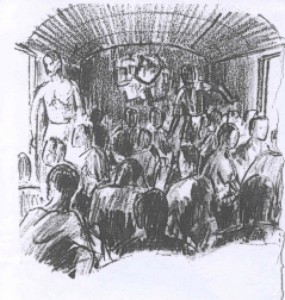
Eventually the time came when my unit was included in the next party to go up country. With fear in our hearts, yet with a show of bravado, we said goodbye to our friends being left behind and paraded in front of the Nip guards and officers. We were loaded onto trucks and driven to Singapore City and then directly to the rail station. At least we took heart that we weren’t going to be expected to walk all the way but would ride on the trains. Eventually the train arrived, but instead of coaches there were only steel cattle trucks. Still we thought, a dozen men to a truck, even at a pinch 15 to 18, the latter a Japanese pinch, wouldn’t be too bad. We soon found to our horror that the Japanese had different ideas to us and we were crowded 32 to a truck. The officers, still believing in their superiority and the need to be segregated from the common ranks, decided to ride on top of the trucks. The doors of the trucks were left open about 8 inches for ventilation.
|
|
|
Cattle Trucks Going Up Country
|
|
We numbered off and took turns standing near the door. Everyone wanted to be near the door during the day when the inside of the truck was like an oven, but at night no one wanted to be there as it was too cold, even the sides felt like ice. We stopped twice a day and men dashed to relieve themselves. Inside the trucks there was only an open bucket and those suffering with dysentery used it if possible, but as you can imagine the stench of unwashed, sweaty bodies and human excrement in that heat was overpowering. At these stops we would be given something to eat, with half a cup of warm water, which was usually very greasy and we felt sure it had been strained from the engine. After the first night the officers came down off the roofs covered in soot and burns from the sparks coming from the wood burning engines. They decided that, after all, it would be more pleasant to ride inside with us. This only added to our discomfort and overcrowding, so they were not made welcome. We continued in this way for five days and nights and never were so grateful for anything as when, after a nightmare journey of about 1000 miles, we were told we had arrived at our destination, Ban Pong in Thailand (or as it was then called, Siam).
Having been ordered off the trucks by the Japanese guards, we were handed over to a new set that looked like the drag ends of their army. Dirty and scruffy, yet they let us know from the beginning that they were the masters and we would do what we were ordered without argument and in double quick time. They led us off, amid the usual mad screaming and lashings from the bamboo rods, to a prepared camp. Prepared was a word that truly stretched the imagination. The huts of atap and bamboo were completely falling apart; one had totally collapsed and was completely unusable. The camp was covered in filth and human excrement caused by the previous heavy rains that had covered the area with about 15 inches of muddy water. Evidently the camp was not built for comfort. After spending one night there we were ordered to fill out forms describing our peace time occupations. You would be amazed at the occupations some men thought up. Those who put down motor mechanic or lorry driver were separated from us and sent out to work in the Japanese garages. The rest of us, after four or five days, were loaded onto trucks and taken to another camp just outside the jungle, Kanchanaburi.
Here we had a pleasant surprise as the camp was clean and well built. We hoped this would be the end of our journey, but once again, it was only wishful hoping. We had heard rumours that we were to build a railway from Bangkok to Rangoon in Burma, but this we just couldn’t believe. Some engineers in our group said the idea had been studied by several nations in the past but abandoned because of the terrible cost in human lives. However, the Japanese had a ready made labour force in the 60,000 odd POWs and they just didn’t care if we died building the railway, at least as long as enough of us lived long enough to complete the task.
In this camp our worst fears were realised and we realized that the rumours were true - this was definitely the plan the Japanese had for us; we were to build the railway in nine months. It was a sobering thought as we knew none of us were fit for prolonged heavy work. Dysentery, malaria and numerous jungle fevers and intestinal conditions were already decimating our numbers. Some were developing jungle sores, others pellagra, while those whom these scourges had not yet visited were rapidly losing weight and some were subject to temporary blackouts. We could have been made more ready to bear these tasks if we had received better and more rations and adequate medical supplies, but these were not available from our captors. The only supplies we were able to get were bought at fabulous prices on the black market, or stolen from the Japanese supplies. Then again, I don’t believe the Japanese had the medical supplies available as they didn’t even look after their own sick or wounded.
We were to find out that the Japanese philosophy was if you were sick you no longer were of any use to them so you were not issued rations or pay. Their men were treated the same as us. You can perhaps understand the worries we had about our future. The conditions we found in Thailand came as a shock to those who had spent all their time at Changi where the Nips had left them to their own disciplines without any interference. We who had been to Singapore on work parties knew what the Nips expected and it didn’t come as such a shock to us. After a few days of rest we were ordered to parade the next morning and to continue our journey.
As we stood on the parade ground - for want of something to call it - the monsoons started and we were soaked from then until we finally reached our destination about 5 days later. At first the march was on flat, easy ground to the next village of Tamarkan, a couple of miles further along. Here we had to cross the as yet unbridged Mae Kwong River which we did in barges. Then we followed up the east bank of the River Kwae Noi which the railway followed all the way up. Beyond Tamarkan we entered the jungle and the land steadily rose in height and became more and more rugged. We felt it almost impossible to walk along, let alone build a railway.
We had started off carrying everything we owned; some men even carrying musical instruments, and we were stepping it out quite smartly. Gradually it began to dawn on us how grim the march was going to be. As we crossed paddy fields, walking on the mounded earth that bisected these fields, the earth became sodden and slippery with the many sliding feet, and we soon found ourselves in the water and becoming acquainted for the first time, but definitely not the last, with leeches. We found that the only way to get them off your limbs was to burn their tail end or wait until they became bloated with your blood and dropped off. We were very happy to see the last of these fields and plunge fully into the jungle.
Such was the confidence of the Nips that we couldn’t escape that we only had a few Korean guards to keep us moving from one overnight camp to the next. Late each evening we would come to a clearing in the jungle where a cookhouse had been set up, here we would pass the night. They issued each man with half a mess tin of cooked rice, a small piece of salt fish and half a cup of tea; this was all we had all day. The experiences of that terrible march will be imprinted in my mind no matter how long I live. Often, in my nightmares, have I dreamed about that march.
To call it a march is to stretch the meaning of the word; it was simply a struggle against all the elements and that cruel jungle. We were awakened while it was still dark, fed a small portion of rice and some warm water, then it was off again, shouldering our belongings. The line was getting longer and longer as the weaker ones were finding it hard to keep up despite the screaming and beatings of the Korean guards. The second day we came to a large camp with many POWs working around it. We hoped this was to be our destination. It was a very large camp and eventually became the base hospital with a very large cemetery. But we were kept moving. Each night we would come to a clearing and there, after consuming our portion to eat and drink we had to decide whether to lay our groundsheet on the mud and bear the rain, or lie in the mud and cover ourselves with the groundsheet. I don’t think too much time was given to making the decision as we were so exhausted we just dropped and slept. Also we had no knowledge what time we would be roused to start off again so it was imperative to get as much sleep and rest as possible. It was a journey into the unknown; we had no idea where we were going or how far, the guards wouldn’t say. Soon we began to pass pieces of abandoned equipment and other things as the men ahead of us tried desperately to lighten their load. From the moment we set foot inside the jungle until we reached our final destination we never saw the sky or the sun, we arrived at each stop at night in darkness and left again before it was light.
Rumours, of which there were always plenty, began to trickle down the line that the Japanese didn’t know what to do with us so they would keep us walking until we all dropped dead from exhaustion and starvation. Another story came up from the rear - don’t drop out because the guards would beat you until you get going again and if you couldn’t they would bayonet you and leave you for the wild animals. Also, we knew that the column was being stalked in the jungle by natives, ready to pounce on anyone dropping out and stealing all the equipment that had been abandoned. Life was grim enough without all these stories. All you could do was plod on, one foot in front of the other, following the man in front of you. He may be someone you knew or a complete stranger, it didn’t matter, you were too exhausted to carry on a conversation but you were all bound together in that one bond of misery.
One night, after “supper” it was decided by our officers that some men were completely unfit to travel the next day and were successful in getting permission from the guards for these men, plus a few more to help them, to have a day’s rest. I was one of those detailed to stay behind to help the sick and thought it was wonderful, however the next day I changed my mind because after a day’s rest we had stiffened up and walking was even worse than it had been initially. Finally we came across some POWs who were working on the pathway and they told us we only had a mile or so to go. I never knew how long a mile could be! As we finally entered Tarsau camp, I was half carrying one of the sick men plus his kit and my own. Many of the men in the camp came out to help us over the last few hundred yards. I was never more happy to lay down my burden.
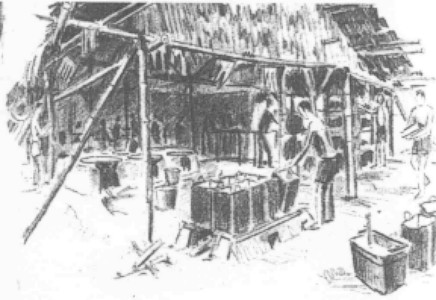
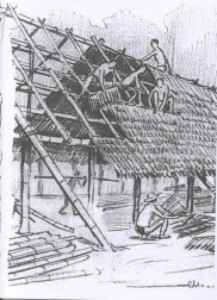
Tarsau was a large camp, built in a cleared area of the jungle surrounded by a bamboo fence. The POWs were inside the fence with the guards and the Japanese were billeted outside the fence. Also, the kitchens were outside the fence on the river bank. The huts that had been built were in good condition although they were low; the edge of the roof almost touched the ground with just enough room for a man of average height to walk upright down the centre. Inside we slept on the bare earth. We were shown our bed spaces and gratefully dropped down and sank into oblivion. We slept the sleep of the totally exhausted.
|
|
|
Atapi Hut
|
|
We were put to work the next day building more huts of bamboo roofed with atap. There were no nails or screws, everything was tied together with a kind of raffia. Each hut was about 200 feet long. Here we were happy to meet up with our old friends from our unit, those from whom we had been separated during that long journey. We hoped that we would be allowed a period of rest and recuperation but we should have known our captors better; the next day we were wakened just as day broke and had to walk down to the river bank for our breakfast. Once again we were back on the usual pap rice and weak, almost colourless tea.
After breakfast we had to parade just outside the fence to be counted. You have never experienced futility until you have survived a Japanese count. We paraded in three ranks and numbered off - in Japanese, with a few other choice languages thrown in with it - and finally got to the end rows with what was the correct number. But was that good enough? No! We had to do it again and again, then the guards counted us themselves and once they could all agree on the number we had to wait while they counted the sick in hospital, those on duty in the kitchen and anyone else they thought had been missed, then add them to the number on parade and hopefully all the numbers agreed. It could take at least 30 to 45 minutes each morning, which was an almost unendurable length of time for those suffering from dysentery. Then we were put to work immediately building more huts.
All day long the air was shattered with the screams of the guards for more speedo. We hadn’t a clue, at the beginning, what we were supposed to be doing or how to do it, but eventually we found it was easy to con the guards into doing quite a bit of the work, ostensibly to show these stupid, thick headed English soldiers how it had to be done.
Each day when we had finished work, we first went down to the river to bathe and then lined up for our evening meal - rice with a little weak vegetable soup, and weak tea. Then most of us, being worn out not only with the work but also the incessant screaming of the guards for speedo and the lashing of the bamboo rods across sore backs, rested and talked over what had happened to us and tried to encourage one another. There always seemed to be some men who were on the brink of giving up and we tried to encourage them to hold on as it couldn’t be much longer before we were set free. We were beginning to find out what life was really like as a POW of the Japanese. We felt that the every day grind with little to eat but rice and maggots was unbearable and was quickly sapping our strength. Little did we realise that Tarsau was a heaven-on-earth compared to what lay ahead for us, or that the time would soon come when we would long to be at the camp at Tarsau.
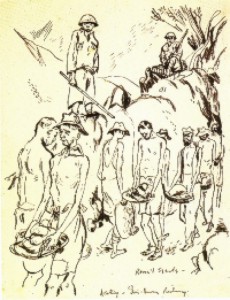
The day soon came when the Nips decided that it was time for us to start to working on the railway project. Each morning we would be separated into different work groups and led out of camp to the area where the railway was to come through. To us it seemed ridiculous, all around was dense jungle, how could anyone imagine building a railway through this. The Japanese had different ideas. To start with we had to clear the jungle from the pathway of the expected railway. For this job we were issued with a few axes, picks, shovels and chunkels - a heavy type of hoe with a long blade. This was fine for the undergrowth, but what about the trees? Surely they would supply chainsaws or something similar, but no, we were expected to remove them with the same tools. That meant that each tree had to be dug around until we could cut the roots and drag it out of the hole. Many of these trees had a nest of red ants in them; they were little terrors. If they got on you they would bury their heads in your flesh and if not taken out completely would fester. A happy pastime of ours was to get a particularly obnoxious guard to stand under the branch hiding a nest, then give the tree a shake. How we laughed as the Nip rushed off, covered in red ants and screaming his head off. One up for us!
|
|
|
Work Party
|
|
By Ronald Searle
|
|
One day a small group of us was detailed to go with a new young Japanese sergeant and we found that we had to build a bridge over a small stream so that the road could go through. Naturally we decided to see how far we could go with the newcomer so we kept asking for a rest period. He always agreed, no problem. This task must have taken a lot longer than the time allotted for it and the sergeant must have been hauled over the coals by his superiors because the next time we met him he was completely changed and had become a brutal sadist.
Rice was still half a cup of rice per day but if you were sick and could not work, then you received no rations from the Nips. They said that only those who worked for the Imperial Japanese Army could expect to be paid and fed. The pay part must have been meant as a joke! Of course we couldn’t allow this so all rations were distributed evenly among the sick and “well”. Day after day, as more and more men succumbed to the lack of food and vitamins they entered the hospital, so our already inadequate rations became even less. All the pleadings of our camp commanders were to no avail; no work, no pay, no rations. Malaria began to be a very real presence amongst us, also another kind of fever, denghi fever, that seemed to last for a few days but was very bad while it lasted. The disease which we came to hate and to fear, dysentery, became even more common. Very few men who went down with that disease at that time ever recovered.
After a few weeks, a group of men from my unit were taken away and we were told they were erecting a new sub-camp, Tarsau South. The rumoured railway line from Bangkok to Rangoon was evidently becoming a very real threat. A few weeks later, when the new camp had been made ready, another group was ordered to prepare to leave camp for Tarsau South the next day. I was in that group. We went by truck along a very poor road to the new camp and there we met up with our friends again. Imagine our surprise when we found our dear young Japanese sergeant was in charge of the work on the railway, but the men told us what a tyrant he had become. He drove the Korean guards mercilessly and although he never touched us he made sure the guards did. They were in as much fear of him as we were.
The head of the Korean guards was a very tall man who was completely mad. At one camp he had been nicknamed “Mad Moti” but at this camp he had a new name, the “Black Prince.” He was completely and utterly ruthless. I personally witnessed him beating a sick man with a six foot iron crowbar; his eyes used to light up with fury and desire to hurt someone. It was rumoured he had been treated badly by the English; whether this was true or not I don’t know, but this I do know, he was a devil incarnate. Each morning we paraded in working sections on the river shore; our sergeant would be facing us, watching for the Black Prince to make an appearance on top of the bank behind us so that he could warn us that “the Prince” was watching. Never have you seen men stand so perfectly still on parade as when he was watching. No man even dared to move a finger to scratch an itch. If the Prince saw you he would punch you up and down the river shore, then send you out to work bloody and beaten. The sick, those men the MO believed unable to work were told to fall out to the rear, then the Prince would inspect them. If he felt in a reasonable mood he would only send about three quarters of the sick out to work, but if he was in his usual foul mood, then the sick would be beaten and then sent to work. This became more prevalent as the work speeded up. I well remember one man who had a hernia in his stomach that stood out like a tennis ball. When the Prince asked him what was wrong he pointed to the lump, the Prince drew back his arm and punched him right on the lump, the man collapsed in pain, but he was still sent out to work. This was the sort of treatment we received in this camp.
After being dismissed for work, we picked up a tool from outside the storage hut and proceeded on a track through the jungle to our work area, about a mile away. Here we were divided into three sections, A, B, and C. B, in the centre, worked out to their left to meet up with A section who would also work out to their left to meet up with the next camp up the line. B section would also work out to their right to meet up with C section who would also work out to their right to meet up with the workers from the camp further down the line. We always worked in the same section so we got to know each other fairly well and helped each other as much as we could. It was a large section we had to prepare and as up to now we only had been clearing the scrub and trees we felt reasonably sure we could manage to hold on until we were relieved by the allies. We still had the fond idea that this wouldn’t be long. It was a belief that privately most of us didn’t really believe. We knew that if we gave up this hope, however forlorn, we would join the ever increasing number being laid to their final rest in a jungle grave. We never even dreamed that before we were finally relieved, a large percentage of these men would be dead.
Life on the track up to this point wasn’t too bad; the work was not too hard or too heavy. We started out early in the morning, arriving at the work site by sunrise and started to work immediately. We didn’t get any rest periods - officially - so everyone cheered when we saw the men come out from camp with a bucket of hot tea. Then we were allowed to stop work for about half an hour, depending on the mood of the guards. We ate our rice balls, that is, if the rice had not turned sour in the heat, and had a cup of tea. Every time the bucket was emptied, we filled it again with water and boiled it up again, each time the taste and the colour getting weaker until finally the only claim it could make to being tea was the tea leaves floating in the bottom. We usually managed to knock off work about seven o’clock in the evening and then after about six checks of the tools to make sure none were missing, we were allowed to go back to camp. Although we were more tired than when we came out in the morning we always did the return journey much faster.
When we arrived back at camp, we had a wash and swim in the river and then had our evening “dinner”, rice and vegetable soup with the always present maggots as our meat. Afterwards we sat around, some playing cards, some talking over old times and memories, while others would go out and sit at the edge of the river by themselves and let their private thoughts wander. Mine always went in the same direction, Exeter, England and my parents and fiancée. How I wished I had a photo I could hold, but she was as clear in my memory as the time I had said the last goodbye. How I thanked God for the years He had allowed us together, and the joy and happiness we found in each other’s company.
Our life at that time centered around the chapel and our faith. On Sunday mornings a group of us younger Bible class members met Mr. Fred Cockram, who had become our spiritual confidant and leader and went for a walk out into the country and talked over spiritual things. It was a time of getting grounded in our faith. We arrived back in time to help with Sunday morning school at Cheeke Street Mission Hall, then went down to the main assembly, Fore Street Gospel Hall for a celebration of the Lord’s Table. In the afternoon we either taught Sunday school or attended Bible class. From five to six o’clock we spent in the hospital conducting mini services then back to Cheeke Street for the prayer meeting preceding the Gospel Service at 6.30. At eight o’clock we held an open air service for an hour. Tuesday evening was Bible teaching, Thursday evening prayer and Bible teaching, Friday evening Bible class in the winter and open air meetings in the summer. Saturdays in the summer would be open air services in two villages, one in the afternoon then move on to another village for one in the evening. We were happy serving the Lord and I thanked God for that great privilege. How I would love to be doing it now. The worst part of the prison camp was having no Christian friends, no Bible, and no Christian services, but I thanked God He had given me a good grounding in the Word to help me through these years.
After sitting alone for a while and doing a bad thing - looking back in memory - this often led to a let down in our physical wellbeing and brought on fits of depression. One was sometimes joined by another soldier who was feeling down and often at the point of giving up hope. Usually the talk started about the work done that day; some of the things we had been forced to do that seemed so senseless - the constant screaming of the Korean guards and the beatings inflicted on some of the men. Then came the inevitable question, did I think the railway would ever be completed? What could I say, I knew no more than this other man but somehow I sensed his desperation and the need to have some reassuring words. So you tried and gradually you could see the tension leaving your new friend. Then it was a case of sharing together thoughts of where we lived and our families and homes, and our loved ones. The ones I felt most sorry for were those who had nothing to look back upon with affection, and nothing to look forward to. One man told me his parents had left him in the charge of his grandmother while they went away for a few days and they never came back. His grandmother was a widow and very poor so he often had to scrounge for his food. Finally, at the age of 14 he left school and went out to work - nothing much, just odd jobs of labouring on the buildings. But he had learned to smoke and drink and spent every night of the week in a public house because it was the only place he could find a kind of friendship. Now, cut off from those things he was complete lost. I told him about my home life, of the parents who loved me and gave me a good home and cared for me, and how at the age of 15 I met a girl and a wonderful friend. He said I was lucky and asked who this wonderful friend was. So I told him about my Saviour. What a tragedy, this was the first time he had heard the name of Jesus Christ as a friend and not a swear word. It brought me close to tears. Finally we said goodnight and went back to our respective huts to try and get some rest to be ready for the labours of the next day. I never saw that young man again and often wondered if he had made it through to the end, and if he remembered what I had told him about Jesus Christ. These talks always helped bring me back into a closer relationship with my Lord, who I was often forgetting. It made me give a new commitment to my Lord that, if I was spared from this ordeal, I would do every thing I could to tell others about the Saviour and spread the Gospel message.
Rest and sleep were hard to come by, if the bed bugs weren’t biting from beneath, then you were being bombarded by hordes of malaria carrying mosquitoes from above, mostly it was a joint attack. Finally you fell asleep through utter exhaustion, both mental and physical. When you awoke in the morning, where you had been lying on your side there would be a large raised area that burned like crazy, that was where the bed bugs had been sucking your blood through the night. Also the smell of squashed bugs was awful. But like it or not, ready or not, another day was dawning and back we went to the daily grind. Fortunately, so far we had all kept mainly free from the many diseases that would soon be our living nightmares.
Out on the track, we went back to the same work which had been steadily getting harder and heavier - trying to move trees measuring anything up to 3 feet in diameter with a pick and shovel. We dug around the roots and down until sometimes we felt we would end up in Australia before we could cut the tap root. We always tried to leave a lot of the root in the ground hoping that the trees would grow again and mess up their railway. Then we had to pull the tree out of the hole and manhandle it away from the clearing, always to the screams of the guards, “one tree, two men” no matter how large the tree was.
One day we noticed a Japanese sergeant carrying a haversack with a red cross on it. He hung around the area for several days and we presumed the Nips were getting concerned about our health. As we sat having a break one day, this Nip shouted something at one of our men. The man told the sergeant what he thought of him, his race and his unwed parents. The Nip just looked at him - this sort of thing happened frequently and we got away with it because the guards didn’t speak English. What a shock we all had when the sergeant told our man to stand up, in perfect English. Then he gave him a tongue lashing and told us he was a doctor in Japan and had passed his degree at Edinburgh University. Then he proceeded to beat the prisoner savagely. That was the end of the Nip, we never saw him again and realised he had just been a plant in our midst to find out if we were getting illicit news. Believe me we were a lot more careful in the future and carefully watched any new guard or Nip who came around.
One day when the lads brought out our tea they told us that everyone back at camp had been put to the task of building another hut beside the guard’s hut. When we arrived back at camp after our day’s work we were all put to work until dark on this new building. Speculation ran wild as to the future use of this hut as it was obvious to us that it was far better than any we had seen so far, it even had wooden plank floors - we had to saw the planks. A few days later we found out what it was. A party of Japanese engineers had moved in. Things soon changed and not for the better. The Koreans were in charge of the camp and the engineers never interfered; also out at the track the Koreans were the people who did all the screaming and beatings. Their treatment of us had become much worse and we realized that it was because the engineers were ordering them to do it. The Korean guards were in mortal fear of the Japanese engineers and did anything they ordered.
The engineers started, with their instruments, to lay out the path of the railway track and we soon realised that clearing it was not going to be any picnic. What we had been doing so far seemed like child’s play compared to what lay ahead. Great stretches of the track lay through solid rock and at other places the track would have to be built up to a high height to keep it level. At still at other stretches there were ravines and gullies to cross. Naturally we thought they would bring up suitable equipment to help do all this, but no. The first thing we encountered was rock. We were issued with long iron bars tapered to a point and 14 pound sledge hammers. Working in pairs, one man held the bar while the other hit it with the sledge. At first we had to drill a hole 35 centimetres deep and that was our task for the day. To most of us, who had never swung a sledge before, it was an almost impossible task and many of the men had their fingers crushed by a badly swung hammer or because their hands were wet with sweat and the hammer or bar slipped. Those who had been coalminers in Northumberland and Durham found they could accomplish the task by noon so they went back to camp and left the rest of us to the tender mercies of the Korean guards. The engineers soon caught on to what was happening and increased the depth of each hole to 50 centimetres, then 65, and then one metre. We thought this was crazy but as the frenzy for speed built up it was finally increased to one and a half metres. Just imagine standing on bare rock, with nothing on your feet or head, dressed only in a G-string, with the mid-day sun often up to 110 degrees, and only a little rice and a little vegetable for meals, swinging a sledge hammer for 12 to 15 hours a day, seven days a week.
If we thought our lives had been bad up to now, the increased savagery of the guards left few without at least a beating with a bamboo rod or the flat of a bayonet each day. We were almost afraid to look up or to wipe the sweat from our eyes because the eagle eyes of the engineers up on the track would see and order a guard to beat you.
At the start of each day we would have to remove the rock that had been blasted the previous day, after we had finished our shift and before we could go back to camp the day before. Then the engineers decided we should all remain at the track until the last hole had been bored, the blasting done, and the rock removed so that we could start afresh each day. Day in and day out this was our lot. As they pushed us harder and worked us longer, our health began to seriously break down and the number reporting sick each day increased greatly. Believe me, if you were going to report sick, you really had to be sick because you had to deal with the Black Prince before you were even allowed to remain in camp. Sometimes he would order all men, including the sick, out to work even if it meant we had to carry some of the sick to the track.
The Japanese engineers swaggered like the big conquering heroes they thought they were, but we were positive that one day they would have to pay for the torture and murder they were committing. The problem was - how many of us would live to see the day? I sometimes thought of the scripture “boast not thyself of tomorrow for thou knowest not what a day may bring forth.” It was a matter of living through this day and hoping for tomorrow.
It is very difficult to put into words just how we felt, the brutal treatment, the inhuman tasks we were expected to carry out, all in such terrible heat, and with very little food, just the same old half pint of rice, lots of maggots and sometimes a little watery soup. We had been aware for some time of our lack of vitamins and the things necessary to keep us alive. Beri beri was becoming rampant in the camp; men were stumbling along on legs swollen to more than twice their size with water. But even more painful and worse off were those unfortunates with beri beri in the scrotum and penis. It was not uncommon to see a man walking around the camp holding his scrotum in both hands to take the weight; often they were the size of soccer balls. They needed good food and massive doses of vitamins but the Nips only laughed and if they were mad enough would hit the man across the swollen scrotum with a bamboo cane. One can only imagine the agony for the POW.
About this time, a group of Australians came and camped beside us for a week. They had good officers and medical staff with them who were not afraid to stand up to the guards; consequently they had much better food and conditions. We went to them and complained about our conditions. The latrines were overflowing and in a filthy state where the men with dysentery had been unable to make it in time. The officer in charge of us was an English captain in the Ghurka regiment. He was afraid of the Nips and wouldn’t do anything that might incur their wrath on him. In fact, I well remember that on one occasion we had to stand and watch this officer and another, standing waist deep in the river slapping each others face because the Korean guards had ordered them to do it, to their great amusement. If they didn’t slap hard enough then a guard would have a go. What hope was there for us with officers of that calibre!
When we complained to the Aussi officers their colonel came into our camp to see for himself. He was utterly disgusted with what he saw and gave our senior officer a complete dressing down. The Australians had fresh meat every day so three of us went over to their camp and offered to help butcher the pigs if we could catch the blood and keep the bladder. They didn’t really need our help but they, I am sure, felt sorry for us so they agreed. Each day we took our treasures back to our camp. We then scrounged some rice and helped ourselves to onions and vegetables from the Nip garden and mixed it all together. Then we washed out the bladder and by stretching the neck as much as possible we were able to spoon our concoction into it until it was like a big ball. Then we put it into a container of boiling water and boiled it until we thought it was cooked. Remember none of us were cooks or had any real idea of what we were trying to accomplish. It was our home-made blood pudding. We cut it in half and took half to the MO for those with the worst beri beri and divided the other half between us. We continued this every day until the Aussies left us. But their colonel had not forgotten our plight. When he reached Tarsau he reported our officer who was immediately relieved and told he would never again be put in charge of English troops.
Although we had a new CO, things did not change much. It was still work, work, work. Our huts were falling apart as we had no time to repair them even if the Nips had given us the materials to repair them with. When it rained it was almost as bad inside as outside. We used to take off our G-strings and wrap anything we had in our groundsheet, if we still had one, and just stood around talking, telling silly jokes, and kidding each other. It was always a tonic to hear the Geordies and the Cockneys kidding each other over their pronunciations. It was good to see our sense of humour had not gone. We often talked of our homes and our sweethearts and wives, also our families and what we did in civvy street and what we intended to do when we got home again. No one ever voiced the fear that was in every heart - that we might never see home again.
As I walked across the camp from the river one day I suddenly blacked out completely, like a light. When I became conscious again I was in the arms of the medical orderly who told me to report sick that evening. This I did and the orderly told the MO what had happened, he had actually witnessed it. The MO checked my chest and said something about my heart and to try and take things easy. It would be easier for an astronaut to jump out of his space craft in full motion and land on the moon than to be able to take it easy in this camp. But really there was nothing the MO could do, the Nips wouldn’t give him any medications or drugs, and they wouldn’t allow us to be off the job.
It made me think, and once again that evening I sat alone on the river bank and thought of home. Once again I could recall quite clearly the faces of my loved one and my family, and I am not ashamed to say that I broke down and cried. After the MO’s latest word on my condition I felt that I would never see them again, that I would be just one more POW buried in an unmarked grave in a foreign land; I felt so utterly alone. But then, in the stillness of that night, I again heard that quiet voice saying “I will never leave you nor forsake you.” I remembered again the verse that brought me to surrender my heart to Jesus Christ, and at that moment I asked the Lord to keep His promise and keep me safe, if it was His will. I had to ask His forgiveness first for forgetting Him. There were no camp services and I had no Bible, and amid all this cruelty and long exhausting working hours, it was not difficult to forget God. I know there are people who will read this and criticize, but they have never been through what we were going through, and I pray God they never will. You cannot know the bitterness of our hearts as we contemplated the future and thought of those who had made the decision to sacrifice us in this way.
We still left camp before daybreak but instead of doing 12 hours, or a certain amount of work, now we never knew when we would return. The camp commander told our officer that the work was behind schedule so it was to be speeded up. All day we slogged in the intense heat and under the constant screams of speedo, speedo, and the lash of the bamboo. We tried, as much as possible, to shield the sick, doing some of their work while they made it look as if they were really working hard, but if they were caught they were beaten mercilessly.
Although we could sometimes escape from the watchful eyes of the guards, we could not escape the watching eyes of the Nip engineers up on top of the railway embankment. Sometimes, even though they treated us badly, we felt sorry for the Korean guards as we were told the English had given their country to the Japanese after the First Great War, and they hated all English because of it. The Japanese had treated them badly, changing their money and forcing them to speak Japanese. They were conscripted into the Japanese army but not allowed any rank at all. Subsequently they became the butt of the anger of the Japanese soldiers. Often the soldiers would beat the guards; this we didn’t like to see happen, not for any love for the guards, but we knew the Koreans would take out their frustrations and anger on the only ones who were lower than they, the only people who couldn’t hit back - us.
Each day, after we had finished our tasks, we had to clear the track while the engineers placed the dynamite and blew it. During this time the Japanese sergeant who had turned so brutal and sadistic laid his plans for that section of the railway on a fallen tree trunk, where we placed our tools for counting before returning to camp. One morning the men brought out our tea and said that everything had gone berserk in the camp. Evidently the sergeant’s plans were missing! The guards back at camp turned everything upside down, searching, but had been unable to locate the missing plans. The sergeant gave us a lecture, through an interpreter, about what would happen to us if the plans were not returned, and when reasoning didn’t succeed he tried beatings. Picking on anyone at random he would demand to know where the plans were and when the POW said he didn’t know he was soundly beaten. The longer this went on and the plans remained missing, the greater grew the frustrations of the sergeant and his anger and cruel beatings. If we wanted to go to the toilet - benjo - we had to show what we would use for paper, usually some leaves or grass. This also made him angrier. Those reading this can never know how we felt as POWs to be treated in this way. We were weak, undernourished, sick and overworked with a lack of rest or sleep, living in fear every moment of every day, wondering what would happen next. We knew that no matter what we did or didn’t do we would be beaten if the Nips or guards felt like it. And we couldn’t retaliate. The thing that made life worse was not knowing if the allies were trying to relieve us, or if they even cared.
Then came the wonderful day when we arrived at the track to find the sergeant missing, he had been removed and we heard he had finished up as a private in a labour battalion as punishment. Eventually the plans were used by some of the men for rolling cigarettes. Life was no easier under the new engineer sergeant but at least we had the satisfaction of having struck back. Actually we were our own worse enemies as we did everything we could to delay the building of the railway even though the further behind schedule the engineers became, the more we suffered.
Soon it became obvious that we would have to start to build up the track. For this job we would divide into whatever number we wished when we arrived at the track, then a Korean guard would mark off, on the ground, an area for us to dig. The dirt we dug out had to be deposited on the embankment. We had to dig and move a cubic metre and a half per man. We tried to work in fours, two to dig and two to carry the earth on home-made litters. Soon we realised that if we had to move this amount of earth we would be out on the track 20 hours a day. So, when we thought we had been out there long enough, we would erase the marks made by the guard and place new ones showing we had finished. Then we would call a guard, making sure it was a different one to the one who had assigned us our task originally. He would then check our work and tell us we could go back to camp.
As the embankment rose higher the earth had to be carried greater distances as well as up the steep sides of the embankment but we still had to do the same amount of work. There was nothing much we could do about it under the watchful eyes of the engineers. We always tried to have a sick man in our group so as to try and protect him as much as possible. But the engineers decided we weren’t working hard enough and the project was still running behind schedule so they decided to set up two shifts of 12 hours each. This way they were getting 24 hours of work a day, or so they thought. The night shift was the easiest, working in the shadows cast by the lights they had set up. We would fill a litter so full it was difficult for sick and weakened men to lift it off the ground, but as we wound our way between the holes the day shift had dug we just tipped the earth into each hole we passed until, when we reached the top of the embankment, we only had about a shovel full left. The guards never seemed to wonder why the holes were all being filled up. We had to wonder what would happen to us if they ever caught on to what we were doing.
We had to use every ruse to outwit the enemy. We were getting thinner and weaker; the number of sick was growing daily, mainly through never having enough to eat. But they didn’t care how many died, they were utterly heartless. We felt we had been completely forgotten by the powers at home and that Winston Churchill did not even think of us as he made sure of his Havana cigars and whiskey. From some rumours that had come into the camp we felt sure that the danger to England from Germany was over, so why were they not doing something for us. How many thousands were to be murdered by the Japanese before the end finally came?
Gradually, despite all our efforts to slow the work down, the work on the railway seemed to be coming to an end. The engineers were always checking their markers and moving them first one way then another. We laughed and wondered how any of the sections could ever possibly meet up. Needless to say, they didn’t. So with screams of speedo, speedo constantly ringing in our ears, we had to widen the embankment in places to allow the sections to meet. One of the worst parts of building this embankment, which was very high in places, was when we came to a deep gulley which was too deep to fill in so had to be bridged. The engineers made us help them build their famous bamboo bridges, some of them as much as two hundred feet high. It was no joke being on top of one being built, working with an engineer who would ask for something in his own language. We would offer him the tool we thought he wanted, then another, until he would scream and hurl a hammer or something of that nature at us always screaming baka (you fool) or Kanero (foolish one). This seemed to be the worst swearing in their language. Trying to duck while standing on an eight inch plank was no mean feat. No one liked this work, but gradually the sections came together.
One thing that stands out most vividly in my memory is the monkey we ate. One of the sections had been bothered for sometime by a large, playful monkey. After the evening meal one day, the Nip in charge of the section came for our sergeant and said “we go kill monkey.” Shortly after, we heard they had been successful and the monkey had been deposited in our kitchen to be cooked for the men of that section. As I sat by the edge of the river that evening, a soldier came to me with a mess tin full of delicious smelling meat. He asked if I was hungry, about the most stupid question he could ask. I said yes. He asked me if I would like his meat; he said he didn’t want it. I took it with pleasure and said I would wash out the mess tin and return it to him when I was finished. It was delicious, the meat was so tender. When I returned the mess tin I found out that I had just eaten a portion of the monkey. It was wonderful.
The work on the track had gradually slowed down until it was completed for our sections. We wondered what they would do with us now, whether we would be left in this camp, sent to another area far to the north, or back to Tarsau. Finally word came that the next day we were to return to Tarsau. As usual we only had one day’s notice of our move. This seemed to be the way of the Japanese, perhaps to keep us wondering what would happen tomorrow.
When we arrived back at Tarsau we found that this camp had changed quite a bit since we last saw it. The huts were better, the old ones had fallen down and been replaced by a much better version. They were higher, with low walls running all down the sides and at both ends which provided some protection from the sun and rains. Also there was a platform down each side, about 12 inches from the ground, made of split bamboo. This was a big improvement from sleeping on the earth but we soon realised that these slats were bedrooms for thousands of bed bugs, so now we had bed bugs coming at us from underneath and dropping off the roof. All night long we were under constant aerial attack from kama kaze mosquitoes. The camp area was quite a distance from the river and it had been completely enclosed by a bamboo fence. The Japanese quarters and stores were outside this fence; also our kitchen was on the shore of the river.
The rations had improved somewhat; usually we had a kind of vegetable stew at night, if the trucks were not bogged down on the earth road because of the rain. Occasionally the Nips would issue a pig for the whole camp; on these days you tried to line up behind a man you knew to be of the Jewish faith and if he received a piece of pork you reminded him he was not allowed to eat it. Also, if we had meat on a Friday we did the same with the Catholics, but after a while they said they had been given special dispensation for the duration of captivity. Work parties still had to go out and do all sorts of odd jobs, but there wasn’t the same mad speedo. We found it hard to understand the mentality of the Nips; they gave better rations to the men in a camp that wasn’t expected to do the hard work for such long hours that we in Tarsau South had. The men who had never left the main camp found it hard to believe what we had been through for the past year, and we hoped they would never experience it.
My unit had, for some reason, found favour with the Japanese camp commander; I believe his name was Major Cheeta. He was a much older man and still wore his First World War medal ribbons. He took our group out every day to repair the road and to try and make it more reliable. Mornings started with fetching breakfast, the same pap rice, and then standing for about half an hour while the Nips counted us. Naturally we didn’t make their job easy; we numbered off in any language we knew as long as the last one finished up in Japanese. Then we would fall out into our work parties. If the major didn’t want us that day, then we had the day off, but those days were few and far between. After roll call we would fall out into our different work parties. Our group would go to the river bank and pick up a 45-gallon drum and place it onto the back of a truck. Then we proceeded to fill this drum with buckets of water from the river.
When I finally returned home after my release, I leaned that at precisely the same time, a neighbour who belonged to a spiritualist church told my mother she had seen me carrying buckets of water up a bank. I don’t understand it but this was exactly what I was doing at that time. Then the truck with the water drum and our rations went out to where we would be working that day and we would fall in and be marched out of camp by the Japanese major.
Once we were out of sight of the camp, he loved to march at the head of the column and every so often he would give us rifle drill in English - our rifles of course were shovels. He enjoyed joining us in singing all the old English army songs as we marched along. I have to say he was a fine man and we all hoped he made it safe home after the war. He never overworked us and gave us a good number of rest periods (yasumais).
The highlight of the day came when the Japanese ration trucks came through loaded with vegetables for the Japanese kitchens, and stopped at our work site. The major would engage the drivers in talk while we usually managed to lighten the load of the trucks from the rear. This way we usually managed to get a fairly thick vegetable stew for our lunch. I am sure he knew what we were doing, but he never mentioned it. When our day was finished he would call us to fall in, give us some more drill and then lead us back to camp. Just before arriving there he would always fall out to the rear. His second in command, a young lieutenant, was sadistic and was always looking for ways and means to get rid of the major and take charge himself. We hoped and prayed this would never happen.
We had been issued with a card on which we were told we could send a message home but we were not allowed to say we were Japanese POWs. It didn’t seem to occur to them that since there was Japanese writing all over the card our loved ones would be able to put two and two together and guess where we were. Some Australians were making a joke of it and writing anti-Japanese slogans all over the cards, they said the cards would never be sent anyway. But I desperately wanted mine to arrive as I knew I had been reported missing and I wanted them to know that at the time of writing this card, I was still alive. When I arrived home I found that that card was the first official news they had received and the first time they knew that I was still alive, after twenty months of anxiety.
Life went on at a steadier pace; there were so many men in this camp that except for our group working with the major, the rest did not have to work every day. Occasionally we were made to parade on the large open space between the huts and the fence and one of their generals would give us a lecture on the wonderful and successful Japanese nation and how well they looked after us. All this was relayed to us by an interpreter. The Nips looked so funny we had to laugh, and they thought we were just being happy and gave us a lot of big-toothed grins. There they stood on a makeshift platform, wearing white uniforms; one would have long leather boots on while another would have tennis shoes, but they all had white socks kept up with sock suspenders.
One day, as I was walking down to the river past the Japanese canteen, a group of very senior Japanese officers came out. As I passed them I saluted but one called me over. He said “Tojo number 1; Churchill number zero”. I didn’t agree with his number one but I did with Churchill being zero but I was not going to let him see that, so I answered “Churchill number 1; Tojo zero.” For this audacity I received a very hearty slap in the face, and the officer again repeated his statement. He received the same reply from me and I received another slap. I wondered what next, but the officers just laughed and pointing to me said kanero.
Despite the slightly better conditions, we were all getting weaker and thinner, being slowly starved to death by a nation who just didn’t care. It was really getting more difficult to keep our faith in our ultimate release. Would the Japanese ever allow any of us to leave the camp alive to testify to their actions against the POWs?
Huts were built to be used as hospitals and soon they became filled as men began to die at a steady rate. It was always a nerve wracking time, as we lined up for our evening mea,l to see a procession of litters carrying the remains of more of our comrades who had succumbed to the bad treatment. Although we became hardened to this way of living, it nevertheless played on your mind in the dark hours of night. I often wondered, and I am sure everyone else did, whether one day I would be on one of those litters. We always gave the men who died the best funeral we could with their comrades from the regiment saying the last prayer over them. One day a man died; he had been sent down from a camp up river and was dying when he arrived at Tarsau. There were none of his regiment in our camp so they asked for volunteers to bury him. I was one of the volunteers. We carried him to the cemetery and there we waited for the padre to come. Finally we sent a man to find him but he came back and said the padre was in the middle of a card game and would come soon. We continued to wait until we were fed up with standing around in the blazing sun, with the corpse beginning to smell. We sent the man back to the padre to tell him if he didn’t come at once we would leave the corpse at the foot of his bed. This brought him in a towering rage to think we would treat him, an officer, like that. When we tried to lower the body, wrapped only in rags, the rope caught around its neck and we couldn’t dislodge it. After trying for a few minutes I had to jump into the grave, lift the body and release the rope. All this was done while the padre was swearing over an open grave. I will never forget that padre; I remember his name but will not print it out of respect for his family.
Although as I have said, the work was not as hard or demanding nor done at such a mad pace, we found certain jobs were very hard. Once again we were called out at any time of the day or night to unload barges of bamboo onto the river shore and then to carry the bamboo up the bank to the camp. Once a few men had done the trip up the bank, which was fairly steep, it became more and more slippery and difficult to climb with a bamboo on your shoulder. But when we came to the twisted ones, then life really became a misery. Sometimes, if the hour was late, or the Nips were feeling extra mean and bad tempered, then we would be ordered to carry two bamboos at a time. When the task was finished we all had very sore and raw shoulders because the bamboos used to spring up and down and in all directions as we walked.
As the tempo of work in the camp eased, we found we had more time to take a good look at ourselves and wonder how much longer we could carry on in this way with the food we were given. Everywhere in the camp were walking skeletons. We augmented our rations in any way we could. Out in the jungle we snared large lizards and snakes and baked them over a small fire. At first we felt squeamish about eating these things but found they were very tasty and apparently did us no harm. As one man put it, in the beginning we didn’t like the idea of eating the maggots, but now we ate them without even thinking. One day, as we came back at the end of the day we came down a hill in the back of a truck and passed a water buffalo going up. We screamed loud until the Korean guard stopped the truck and we told him to shoot the animal. He was scared to do this; the buffalo had a bell around its neck so it obviously belonged to someone. When he realised that if he didn’t shoot it we would laugh at him and he would lose face, he did his best. Finally, after wounding the beast he finished it off at point blank range. We loaded it onto the truck and when we arrived back at camp it was taken to the Japanese kitchen to cut up and we received a big portion. It was cooked for the evening meal, and although on the tough side we enjoyed having something to chew. Next day we were visited by a very angry native farmer who wanted his buffalo back.
Another time we found an old mule wandering around in the jungle and he also finished up in the stew pot. We would eat anything to keep alive. The Nips had brought in a lot of ducks and put them in a large home-made pool, but when they realised their numbers were being rapidly depleted, they put POWs in charge and said if any more vanished the POWs would be shot. Another time we raided the Japanese officers’ chicken run and caught ourselves a supper. At that time we were sleeping in tents and had to keep a fire going in between each tent to keep away the wild animals. We had this chicken in our tent, plucking it, when we were told a sentry was approaching. We grabbed a blanket and pulled it over the chicken but the feathers were still flying around when he looked in. For some reason he never put two and two together; if there were chicken feathers there must be a chicken. But we realised that despite all we were doing we were losing the battle, we were still getting weaker and thinner. Men now were dying of problems because of the lack of strength, and they should not have been if the Nips had fed us properly. Also it didn’t help our morale any to hear the stories coming down from the camps up river where the first groups had been almost wiped out completely by disease, starvation and sadistic treatment, with no medication supplied by our captors. The Nips must have known what would happen to the men before they sent them up there.
Despite all that we had to suffer, life was not without its lighter moments. While we were sleeping in the tents the nights were extremely cold so we decided to double up, using the blankets to cover ourselves and the heat from our respective bodies to keep us warmer. I doubled up with a man called Ernie Webb from Dover. Ernie was a very restless sleeper and several times a night I would have to poke him and tell him to move over to his own side. Some nights I would get fed up with this and would climb over him and change places. Ernie could never understand why, when he woke in the morning, I was on the opposite side to when we went to sleep.
The Korean guards were very afraid of the dark, especially the thought of wild animals. One night I felt what I thought was Ernie pressing against me and kept poking him and telling him to move. Finally, getting no response from him, I gave him a hard poke with my elbow. I heard a grunt and felt my elbow hit something very hard. I sat up quickly to find the Korean guard had dropped in between us, he was so scared. Ernie was a short very stocky man with rather a large head. He suddenly decided one day that he was going to have all his hair shaved off; we laughed, he looked like a large billiard ball. He was very good hearted and didn’t in the least mind being kidded about his new hairdo, or being asked if he had a comb he no longer needed.
We began to hear about the terrible toll that was being exacted from our numbers to build the railway. The camps up country had been completely decimated through disease, inhuman work conditions, starvation and brutality. All their food had to come up to them from the base camp and when the road was impassable because of the heavy rains, the trucks didn’t get through, and so the POWs received no rations. I am glad that we did not know the true figures or else we would have given up hope as it seemed we had been completely forgotten by those at home, and could expect no help from them.
After the war I heard that the railway had claimed the lives of 16,000 allied POWs and over 100,000 of the civilian population, all in less than 12 months. The higher figure among the civilians was due to their complete lack of hygiene, One would get sick and crawl off into the jungle to die, and the flies would feed on the corpse and bring the disease into their camps. But there had been no need for this appalling rate of death. If the Japanese had given us better equipment to work with, decent rations and had allowed drugs into the camps, and above all if they had shown a little humanity, the numbers would never have been so high. But they had shown themselves to be utterly depraved and ruthless; they would allow nothing to stop the progress of the Imperial Japanese army. Their policy toward the sick was crudely laid bare by the commander of No. 5 Group in Burma who declared: “Any sick man who staggers to the line to lay one sleeper will not have died in vain.” While another officer exposed the nature of the POWs dilemma with the words: “You do not understand us. We will build this railway if necessary over the bones of the POWs.” We had seen the track layers coming through, one lot were the men I had worked with at Keppel Harbour who had kept together under the command of the same officer who was still looking after his men to the best of his ability. The day finally came when we heard a train whistle and knew that the line was finally in operation. Now perhaps we could relax!
I experienced a new ray of hope as I realised I had come through that terrible time and was still alive to tell the story, but then the malaria really started to become a trial. Suddenly I would feel very nauseated, sweating profusely yet shaking like a leaf on a tree branch during a storm. When I reported sick, it was diagnosed as malaria so off I was sent to the hospital hut. The first time I entered the hut as a patient I was scared, so many men left there only to be carried to the cemetery. Again I prayed to God and asked Him to watch over me and if it was His will, to cure me. I don’t know what I would have done if I had not had the knowledge that my trust was in God and I could always find help at His throne. We were given a small dose of quinine, half a dose a day for three days, then back to light camp duties for three days and then back to full work again. A couple of weeks went by and then I was back in hospital again with a recurrence of the same problem. This was a routine I had to live with for the rest of my captivity.
|
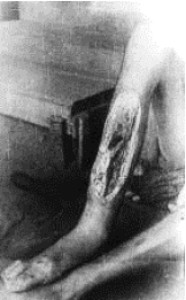
|
|
Tropical Ulcer
|
|
Then I had a spot come up on the back of my right thigh, quite high up. It looked just like a pimple with a white head but when I squeezed it out it left a deep hole. When I reported sick, the MO ordered a rice poultice put on it and light duties. I laughed and thought I had got away with not having to go out to work for a few days. But within twenty four hours I was not laughing any more, that little pinprick was the size of a dime, and it continued to grow each day. I was very scared as I knew it was a tropical ulcer and one only had to walk through the hospital and witness what tropical ulcers could do, to know you could quite easily lose your limb. The MO had been chopping off limbs left right and centre and was even boasting about how fast he could take a leg off and with only makeshift implements. He had become what we called “Japanese Happy”. Everyone with an ulcer was scared to go near him as he never seemed to try and cure it, just cut off the limb.
A Dutch surgeon came up with a new idea for treating ulcers. Instead of just swabbing out the ulcer twice a day, he suggested cutting back into the good flesh and so removing all parts of the disease. There was only one problem, there was no anaesthetic. I was very thankful I could faint easily. As soon as he touched me with the knife I was out like a light. They decided that, as there were so many amputees, they would built a new hut just for them. It was truly a big uplift to go and visit men there and see how they were living with their difficulties. Some of them had lost both arms or both legs, or one arm and one leg, yet they remained cheerful. They always maintained they were the lucky ones as the Japanese couldn’t send a man out to work with no arms. Once again the ingenuity of the men came through. They fashioned artificial limbs out of army mess tins and webbing equipment. How I remember that in the quietness of night I thanked God for sending help in the form of the Dutch MO and that my ulcer had stopped growing at about 2 inches in diameter.
Often I went to visit a friend in hospital who had had a bad ulcer and the MO had removed one of his limbs. One man in particular was nicknamed “Soapy” Hudson and he was one of the unfortunates who had no real home life and nothing to look forward to or memories to hold on to. I went to see him and he was full of self pity and whining about how he had lost his leg. I got very angry with him because this attitude would only take him to a quick grave. I told him to stop whining and moaning and move on with his life; if he thought he was hard done by, take a trip through the amputee hut and see men with both legs missing who were not complaining. It was a hard way to talk and inwardly I felt terrible doing it, but we all realised this was the only way. Unfortunately we buried “Soapy” within the week, he just gave up. If only he had known the Saviour he would have had hope for the future. In reality, we had become so callous and indifferent to the fate of our fellow men that we just shrugged it off and thanked God it wasn’t you. I was devastated when I heard a good friend “Tiny” Tapster - so named because of his tremendous size - had died in another camp upriver. If a man like him died what hope was there for the rest of us.
Life took on another turn, in hospital with malaria, out on light duties for about a week then back to full duties for about two weeks, then back into hospital and start the cycle all over again. The only difference being, each time you came out of hospital you were a little weaker and thinner. Then as I went to the latrines one day I saw a lot of blood and the pains in my stomach were very bad. I reported sick and the MO confirmed my worst fears, dysentery. Into the dysentery ward I went and then came day after day of agony and loose bowels. There were no beds in the dysentery ward because they couldn’t be kept clean so men lay on the earth floor. You called for the orderly to bring a bed pan but hardly ever were they in time, so you lay in your filth and stink until either the orderly could find time to clean you or a friend would drop in and do it. I felt so bad and weak, and it seemed that it was never going to improve. I well knew that most of those who contracted this disease finished up in the cemetery. I remember at night in all my pain I cried to the Lord to take me home, or to relieve the pain and cramps and make me better again. Thoughts of home flooded my mind as I spent hour after hour in this way.
At the end of the hut were three bays where they put men who were not expected to live through the night, so others would not be disturbed or distressed when they took the dead one out. There came the time when I was conscious of being moved and as I lay there in my new place I realised there were atap walls on each side of me and I knew I was in one of the death bays. I honestly don’t know what happened that night, but come dawn I was still alive and taken back into the general ward. From that moment on I steadily improved until finally I was discharged, very weak and thin, but still, thank God, alive. To God be the glory, great things He had done. He had heard my cry in the night, although I was not conscious enough to know I was calling to God for help. I was excitedly welcomed back by my friends in the hut where I slept before becoming hospitalized. Many expressed the opinion they had never expected to see me again; it was like one returning from the dead.
At about this time the Catholic padre received permission to hold a communion service and he made it known that it was for men of all beliefs and denominations. What a joy it was for the first time in about three years to remember the Lord once again. I now had so much more to thank Him for. The bread was a bit of hard baked rice cake and the wine cold weak tea. But it was the knowledge we were following our Lord’s command that made all the difference. We were only a small group of about 30 men, sitting on the hard baked earth in the sweltering sun of over 100 degrees, but what a difference it made to my life for a while. It brought me closer to my Saviour and I felt a new hope.
Then the dysentery started again and the agony in the dysentery ward. Could I withstand a second bout? Once again I prayed to God for help. This time I was again put in the death bay and I had just about given up all hope. I was covered all over with tropical ulcers and still having the regular bouts of malaria. I was at the lowest ebb I had ever been in the prison camp. That night, as I lay in the death bay, I had a dream. I was in my parents’ home; there was my mother in her armchair with my sister crouched down beside her, my father in his high back wooden armchair and my fiancée sitting on a chair, all in a semi circle before the fire. They were looking into the fire, no-one speaking, but I could see in their minds they were thinking of me. I am positive that God gave me this dream for something to hold on to. Next morning the MO said “you just don’t want to die, do you?” I replied “no, I believe God has something He wants me to do”. From that moment on I started to recover and very weak, weighing only 73 lbs, I returned once again to my friends.
I was concerned with the tropical ulcers that were covering most of my body, from the top of my feet to my shoulders. They were all oozing puss and bleeding and the flies around them nearly drove me out of my mind. I was no exception, there were hundreds like me, but this is my story. I reported to the MO but was told all that could be done was to wash them out to the best of my ability. Nothing seemed to work; perhaps it was the sweat and dirt getting into them all day long that made them worse. It was something we could not understand, we thought you only got an ulcer after being scratched by a bamboo. Perhaps this was the case but we didn’t realise how often we were being scratched as we cut the bamboo for the fires.
Our main thought, every waking moment, was how to get enough to eat and try to stay alive. It was a matter of living each day for itself and try not to think of what tomorrow might bring. Men were dying every day and still the Nips wouldn’t give us any drugs. What little we had was bought on the black market at tremendously inflated prices. The Nips had finally condescended to pay us for our labours, $1.00 a month, but they only paid three or four times during the three and a half years of our imprisonment. We each gave 10c of what we were paid to the hospital.
Each day I became more and more aware of the ulcers that seemed to have a desire to cover my whole body. Imagine the pain of being out slaving all day with hordes of flies attacking the sores! It was a life of misery and you longed for the day to end and the flies to leave you alone for the night. Finally I could take it no longer and decided something desperate had to be done. I borrowed an army hair brush from a friend and went and stood in the river and scrubbed every ulcer until it bled; it was sheer agony and in my weakened condition I felt like passing out, so I just rested for a few minutes and then carried on. Often there would be several of us, living scarecrows, doing the same and encouraging one another. After doing this twice a day for a couple of weeks I began to see the results and one by one the ulcers dried up.
You got over one thing and then another one would start up. I guess that because of our weakened condition we had no resources to fight sickness. Now my ears started discharging very badly. I had to report to the MO every day and he just swabbed them out and apologised for not being able to do more. He said there was a growth in both ears. One day he tried to cut a piece off inside the ear with a scalpel; just a dinner knife sharpened to a point, but the growth kept slipping off the edge of the blade, it wasn’t sharp enough. Now I had got rid of the flies on my ulcers but they congregated in my ears. Several times a day I would take out the cotton wool, squeeze it out and put it back in again after being handled with dirty hands. I can’t explain how miserable this made me feel and as I saw the dead being carried out each day, I began to think they were the lucky ones; they had left the misery behind. Rumours were constantly being brought into camp that the war was over, but for some reason no-one ever told the Nips.
Then a new but more terrible rumour came into the camp, something which we soon found out was not rumour but fact. The dreaded disease of cholera had hit the upriver camps and the men were dying in the hundreds. There was no cure available in the camps and any man contracting the disease had no hope. We hoped and prayed that it would not hit our camp, but of course it did and it threw everyone into panic. What a difference it made to our existence; we lived in fear of the mostly unknown. All we knew was that if it hit, you would be dead within 48 hours, and those 48 hours would be filled with unutterable agony. I will never forget the first one in our group who contracted this vile and deadly disease. We had returned from work and had washed in the river as best we could; we were forbidden to wash above our shoulders or to let any of the water touch our face. Then we received our evening meal and retired to our sleeping huts to eat. Suddenly one man laid aside his mess tin and went to the latrines. He came back but after a few minutes he went again, this time he was hurrying a bit faster. The next time he went he was running a lot faster, afraid he wasn’t going to make it in time. We all looked at each other but no-one dared utter their thoughts. When the man came back again it was obvious he was in great pain. Answering our questions, we understood his motions in the latrines were like milk and running from him in endless pain. We called a medical orderly and he immediately ordered the man to leave everything and report to the cholera hut. Our hut was placed in quarantine and we were ordered only to use the latrines for the cholera patients. We felt this was totally unfair as we didn’t have the disease but were being forced into the midst of it. I guess they knew more than we did as, one by one, men left us for the cholera hut until, after a week only about half a dozen of us were left. We would lie in our hut trying not to think about this sickness. You would look up and catch someone looking at you, he looked away quickly, but you knew what he was thinking, will he be next! It was a time when you only had your faith to keep you going and help you not give up hope.
Our officers did everything they could. When we lined up for our meals there were two 45-gallon drums of boiling water and we had to dip our mess tins into each of them and then receive our rations. It was then up to us to keep the flies away. An officer stood behind each bag of cooked rice and if he saw a fly pitch on top he ordered the top layer to be skimmed off and thrown away. This made our already insufficient rations smaller but we were willing to try anything to stop this plague. The men who died, and there were many every day, could not be buried but had to be cremated on a huge bonfire. Gradually the number of deaths eased and we were told that a number of the sick men were being evacuated to a base hospital camp down river. I was not one of the fortunate ones even though I was continually suffering from malaria and had had two bouts of dysentery. Those selected to go were paraded on the river bank ready for shipment by native barges down river. I felt so disappointed at not being selected I felt I could not go down to the river to see them off. Suddenly I heard my name being called; it was a staff sergeant who asked if I would like to go down country with the sick. What a stupid question! I asked how come and was told one man had died leaving room for one more. Gladly I took his place and boarded the boat and came down to the base hospital camp at Tamuang. Once again I was conscious that God was keeping His promise to look after me.
It was about this time that another new problem had cropped up - worms. We heard a man had died in hospital after choking on a worm. The joke went around the camp that the maggots we had eaten were now grown up into full worms. But it was no joking matter. I remember my first; I saw it in a stool - it was about 10 inches long. I took it to the orderly who looked at it and told me to get rid of it and report sick. I asked what I should do with it and he replied, it was my worm, do what I liked with it. It was not an unusual occurrence to be talking in a group when one man would start coughing and almost gagging and out would come a large worm. These persisted until I was in a rehabilitation centre for ex-POWs and I had two treatments to rid them from my insides.
When we arrived at our new camp we were met by a number of the men who had been in the camp for quite a while. Many recognised old friends and joyous were the many reunions. We were told this was a far better camp than any we had been in before, the only work parties were to collect fuel for the cookhouse fires. When we entered the camp itself we were struck by the openness and cleanliness of it; the good huts with walls at least three feet high. We were shown our hut and soon sorted ourselves out into regiments or units. Many of us from the 18th Division Signals were there and naturally we kept together. Somehow it seemed to make things easier being among friends, those we knew. We reached a camaraderie that I don’t think would have been possible under any other circumstances. We looked after one another; if one man seemed a bit down the rest of us would do our best to lift his spirits. We organized ourselves so that one man in six would go down to the kitchen and bring up breakfast for the other five, this way we could manage an extra 15 minutes or so of rest. This was something our bodies needed. We were kept busy keeping the place clean and building new huts, and even if the food had not increased either in amount or variety, without that constant grind, screaming and beatings we had been used to we figured we could manage to see this next period of our lives to a happier conclusion. Rumours had started to come in that the allies were bombing up at the northern borders and the POWs and many Japanese were being rapidly sent down river. Feeling overwhelmed with relief with the suddenness of my escape from the upcountry working camp and the journey down river, I lay on my bed space and tried to relax and thank God for His watchful care over me. Suddenly I heard my name being called, or rather a nickname a friend of mine used to call me. But I couldn’t believe my ears, Tiny Tapster! But I had heard he had died up country! Then someone pulled my foot and shouted to me to wake up. Rather fearfully I opened my eyes and there, much thinner, was Tiny with a great big grin on his face. When I told him I had heard he had died he laughed and said he had nearly died, but not quite. It was wonderful to see him again and renew our friendship; it gave me a real lift.
Life in this camp was so different. Although men were still dying because of their weakened conditions and lack of medicines, and we still had our starvation diet, life without the constant screaming and heavy work loads on the railway, made us feel like we were in a paradise of our own. Gradually things became organized. At night men used to go around the huts and tell a story or relate a holiday memory or something of that nature. One officer used to come and we made two sides of four men each and he gave us a quiz. He would describe a well known advertisement of the billboards of England and ask what they were advertising. We had a lot of laughs and it also made home seem a little nearer. One of our little group decided to write some one act plays and we would go around the huts performing them. We would sit in a circle around a homemade lamp and read our parts. We may not have sounded very professional but it helped us, and the members of the hut, to forget our conditions for a little while.
Then someone decided to organize soccer games on the large open area in the centre of the camp. Each hut would have a team and great was the competition even if the skill often left a lot to be desired, but it made for many good laughs. Then naturally we had to have international teams, and as I wasn’t good enough to play for England, but as I had relations living in Wales, and they were short of men, I played for Wales. Who really cared what nationality you were as long as we were having fun? It was while watching one of those games I lost two front teeth. One man kicked the ball out over the touch line and a man down further put up his fist and diverted the ball right into the centre of my face. The shock made me push my tongue against my front teeth and two of the top ones broke off. This loss wasn’t anything to worry about; I didn’t need teeth to eat rice and a little soft vegetable.
Life went on steadily, I was still getting my regular bouts with malaria and my friend Johnny Brecht was as yellow as a banana, also suffering with pellagra - a very dark scale all over his feet which were very swollen and sore to walk on. All these things were due to a lack of vitamins.
There was only one thing that was really worrying in this camp, an increase in stealing. You didn’t leave anything you owned lying around, especially outside where you couldn’t keep your eye on it, because it soon vanished. In a way I could sympathise with most of these men, they were doing whatever they could to stay alive, but it was wrong to put other men’s lives at risk. We didn’t know how to stop it. If a man was caught he went before a senior officer on a charge and was sentenced to so many days of fatigues; we often saw men being paraded around on the open space wearing a heavily loaded pack, and being drilled by a sergeant. But it didn’t really register on us, all we knew was that a man in a certain hut had been caught stealing, but only those around him knew who he was. Then the officers had a brilliant idea. Now, every evening as we sat on our bed spaces eating our evening meal, there came a parade of men with a notice around their neck “I am a thief.” Now we knew exactly who they were and we could keep an eye on them in the future, if we had a future! It was harsh treatment but it certainly was effective and greatly cut down on the stealing.
Then the Japanese said that the worst of the sick would go down to a prepared hospital camp outside the jungle. My friend Johnny was one of those chosen. As we said goodbye to each other we both wondered if we would ever see each other again. Several of our unit were in this group, including two Scottish brothers and my friend “Friar” Tuck whom I had helped in his tailoring business at Tarsau. Although this new camp sounded wonderful there were no volunteers, better the mess you knew than the unknown. Also, we remembered the many promises the Nips had made before about a wonderful camp, only for it to turn out to be anything but. The number of sick was building rapidly as many of the desperately sick from the upcountry camps were being sent down river.
The call went out for volunteers and I decided to be one of them. The job, to start with, was to give physical therapy to those who needed it. I still remember my first patient, a Scots lance-corporal in the RASC. He had been lying on the dirt floor with his legs bent up to relieve the pains of dysentery in his stomach and he could no longer straighten them. I was asked to give him therapy and exercise to help him but I felt they thought he was a hopeless case, the dysentery would take him and he would die. I took a liking to him and we talked about his home and family life, and the one little daughter he had never seen. I felt that this time of closeness together was more what he was in need of, something to take his mind off his condition and a chance to look forward with some hope. Gradually the dysentery eased so I tried to get him interested in himself and getting better. I boiled water and bathed him and asked the camp barber to give him a haircut and shave. This he refused to do when he saw the sunken cheeks. But I had promised Jock a haircut and shave so I borrowed a pair of upturned scissors and patiently cut off as much of his beard as I could, then I gave him a haircut and shave. It certainly didn’t look anything like a professional job but when Jock looked in a mirror and saw how good he looked, and how clean, his spirits revived. I half carried him outside to sit in the sun and then came the day he walked out on his own. How we both rejoiced! I persuaded the MO to put him on a portion of diluted condensed milk to build him up. You could never imagine the difference in him; the MO said he had never expected to see Jock come through it. Then came the morning I found Jock back in bed again and he said the dysentery had started again. I questioned him to find out what had caused this and he finally admitted he had left some of his milk overnight; it had gone sour, but he drank it anyway. We buried Jock about 3 days later. I went out to the perimeter fence on my own and cried; what a waste of a young life.
Then I had more patients added to my load and I had to help out in the general wards, helping the orderlies to clean out the ulcers. You can never imagine the size these ulcers can grow to in a very short time until you have witnessed them. There was one man, I remember whose whole shinbone on one leg was completely exposed, the ulcer had eaten all the flesh away and it was still growing. Another I treated had a rather small hole near the top of his spine and another near the bottom. They didn’t seem bad until you realised that they were joined together by a large tunnel where the flesh had been eaten away inside. I used to have a long piece of rag, and gently pushed it inside the top hole with a thin bamboo until it came out the bottom hole, then I worked it up and down to try and clean out all the puss. Also, on one occasion I had to help in the operating theatre on a post mortem on a man who had died unexpectedly. These post mortems were only carried out with the permission of the man’s senior officer in the camp, to try and find out anything that might one day help someone else.
On three or four occasions we were called out at night and driven to the railway line where we found a train emptying POWs from upcountry. What a state they were in! They had had nothing to eat or drink and no treatment during the journey which often had taken four or five days. They told us they had to evacuate the train on several occasions owing to planes strafing them. We loaded them onto the trucks and took them back to camp and to bed. Next day we sorted them out into their different huts according to their problems. It was terrible to go into the ulcer ward; you could smell the gangrene and knew a lot of them were just not going to make it.
One night when we were called out we found a train at the track full of wounded Japanese soldiers, many of them just lying at the side of the track where they had been left by their orderlies. They were starving, thirsty and dying for the lack of medical treatment. We really got angry with the Nips for treating their own wounded and sick in such a disgusting manner. We gave the wounded all the water we had and scrounged around for what food we could get for them. Many of the men who smoked shared their cigarettes with them. We never thought we could be so compassionate to the enemy, but you just couldn’t shut your eyes and ears to their agony and misery. If this was how they treated their own, it helped us to understand why they treated us the way they did, after all in their eyes we were less than nothing. But these men were those who had been wounded in battle, not the Koreans and Nips who had never heard a shot fired but just enjoyed beating us. It showed us that no matter what we had been through, what atrocities we had witnessed, the starvation and the beatings, we still had a sense of decency and compassion.
Life fell into a steady pattern, there was always someone coming in from a work party who had met a well dressed Eurasian who had told them the war was over. Our hopes soared. Even though in our hearts we didn’t believe it, we needed that stimulation to keep on going and keep on hoping. It was the only way we could keep on going day after day. At the beginning we really believed we would be released very soon, but now, after three years, that hope had faded. Then we got another shock, the Japanese demanded that another large group be ready for shipment to Japan. Many thought this would be a good move as surely they would be treated much better in Japan. But after the war was over I met some of the men and they said their conditions in Japan were every bit as bad as the months on the railway. I was chosen for this party and on the morning of our departure we paraded for an inspection by some of the Japanese top brass. I had started another bout of malaria and was shaking badly when they came to me. The senior Nip took one look and bellowed and pointed, I thought he was going to have a fit. Then he pushed me out of the line and said “No.” So I remained behind. Again, after the war when I met some of the men from this group, I heard they had been torpedoed by an American submarine. They had been locked below in the holds and had difficulty getting out. At first the Americans made no attempt to save them, until one realised they were ex-POWs, then they were hauled aboard and taken to safety. But many did not make it.
Actually things were happening that would have told us how badly things were going for the Japanese if we had only stopped to analyse it. Vegetables had become in short supply, so the Nips decided to grow their own. We had to dig the garden and then fertilize it. You would think this wasn’t too bad a job. But for fertilizer we had to go to the latrines and dip out the contents, maggots and all, and carry it on litters made from rice sacks and spread it on the gardens. The rice sacks leaked so that after a couple of trips we were slipping and sliding on human excrement and maggots. At least this treatment made it sure we wouldn’t steal any of their vegetables. We couldn’t believe anyone would eat such things.
The air raids really started in earnest. It was exciting to see allied planes overhead with no opposition. It threw the Nips and Koreans into a blue funk. This was the nearest they had ever been to any action, but we were excited as we realised our troops were near enough for bombers to come. It gave us new hope. Then one day we could see up the river and saw the planes bombing our bridge. We shook our fists and screamed at them to leave it alone, of course they couldn’t hear us. We were not concerned with the hold up of Japanese personnel and equipment, all we could think about was that would have to go back up and repair the damage; back to all the screaming speedo and beatings, only this time there was the fear of our own planes bombing us. Many smaller groups had done this when the allies bombed portions of the track and our men had to go back and repair it. So it was with the bridge, but not men from our camp. It was the men that had gone down to the base hospital camp that were forced back up the line to re-open a camp riddled with disease, lice and bedbugs, and forced to work repairing the damage. In their already weakened state they died like flies in winter.
The next shock came when the Nips suddenly ordered our senior officer to arrange a fairly large party to go to another camp. Once again I was one of this group and we boarded trucks and were taken down country to a camp out in the open amongst the paddy fields, about 80 miles north-east of Bangkok, Nakhon Nayak. At first sight the camp looked good; the huts were fairly substantial and obviously new. It was surrounded by a bamboo fence with the deep trench behind it and a high mound of dirt behind the trench. They said the fence, trench and high earth bank were to stop us from escaping, but we couldn’t help wonder why such precautions after all this time. All the camps had had to dig this trench around their camp, and throw the earth on the far side, so that first you had to climb the fence, then jump the trench, then climb over the earth banked on the other side, before escaping. We didn’t believe for one moment that this was the reason, especially when they erected machine-gun posts strategically along the trench that would cover all the angles, including a sweep of the camp. After hearing they were going to kill every POW if the allies made a landing in Thailand, it didn’t make us feel any happier or more secure. Were we to go through all we had only to be slaughtered at the end by the enemy.
One day, I remember we were digging the deep trench when the planes came over quite low. There was immediate panic, with the guards screaming at us to go back into camp. Naturally we took our time, laughing and cheering, despite being slashed with bamboo rods and bayonets. We also felt worse about our location when we realised we were in the middle of a large concentration of Japanese troops. We heard, after the war, that they had done this with other POWs, some being billeted near ammunition dumps and others near docks, while others ended up in the middle of large anti-aircraft gun positions.
In this camp we were told there would be only two work parties each day, one to collect wood for the kitchen fires and another to work for the Japanese. All our officers, except a padre and a medical officer had been taken from us and put into a camp a mile or so up the road. We had to go through their camp to carry anyone who died to their last resting place. The Nips had the idea we would not try anything if we didn’t have the officers to lead us. Each morning we paraded outside the fence and those who had the wood detail fell out with a guard and those who were left but not sick were marched out of camp. We went about a mile up an almost straight road, and then turned right onto a dirt road which led into the foothills. When we got to the end of this road there would be the usual brutal Japanese engineers who would demand so many to work on the road, and those men really worked. The engineers demanded the same men each day so they had no relief from the sadistic brutality of these engineers. The rest of us went on into the hills and were put to work digging caves in the hillside for storage of ammunition and food for their retreating troops. We could tell, what with the air raids and digging those caves so far away from what we believed to be their front line, that things were going very badly for them. Now we began to feel the end was really very near, but we worried that the Nips would carry out their threats to kill all the POWs.
Many of the camps were coming under bombing and strafing raids by the allied planes, because they were so close to military targets and many of the POWs were killed. Now there was the fear that we may have come through the horror of these years only to be killed by our own side!
Out on the job digging the caves we took it easy and it seemed as if the guards were not very interested, unless one of the engineers should come up to inspect. The guards spent all their time shouting to one another items of news, and in this way we were able to pick up a word or two here and there and get some idea of what was happening. It was very evident that the war was going very badly for the Japanese and the end seemed near. The Koreans seemed to be afraid of what the Japanese would do to them.
Each day it rained at almost the same time and if we were late finishing work we would be caught in the rain while marching down the road. It was funny because the road was almost dead straight and you could see the rain chasing us down the road. So we marched faster until we had the guards running to keep up with us and getting angrier by the minute. But it was all to no avail, the rain travelled faster than we did so when it caught up with us we just took off our G-strings and washed in the lovely cooling rain as we strolled along. At this time we went as slowly as possible in order to get the guards as wet as possible. All this may seem to be childish but we did all we could to make the guards angry. As we marched along we started to sing all the old songs, especially “I’ve been working on the railway,” and another favourite, we weren’t allowed to sing our National anthem so we used to sing “Rule Britannia,” and laughed loud and long when we came to the line “Britons never, never shall be slaves.” We had been just that for over three years.
Little things started to happen; the Nip sergeant in charge of the camp was a bald headed elderly man, so naturally he became known as “Baldy.” Now he was getting much nastier, always shouting and pushing us when on parade for roll call. We wondered what had suddenly happened to make him so upset. Another problem was the local natives who, when they wanted to drain the water off their paddy fields just broke down the walls and let the water run all over the road and into our camp. More than once we woke in the morning to find 2 feet of water under our beds. Then we had the job of going out and repairing the breaks in the walls of the rice fields and trying to dry the camp out. We had a lot of fun swimming around trying to rescue different pieces of vegetable. As we no longer had the officers with us, the senior sergeant-major took control as camp commandant and we started weekly church services. The padre had to write out his sermons and present them to the Nips for their OK. This was how the enemy got the gospel as well. But one day the padre’s message upset the interpreter and all services were forbidden and the padre confined to his bed space.
We often sat around and discussed what we would do when it became obvious that the war was nearly over; how we could overpower the guards and where would we go. We remembered that we were in the middle of a large Japanese troop concentration. But the end came with absolutely no warning, we had no idea what rejoicing that would bring, nor how close that day was.
Next Chapter
Freedom At Last
|